| |
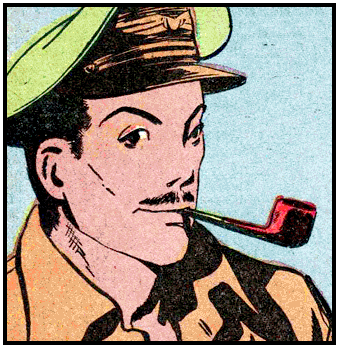
Rackman: 1947, Clue Comics #12 (Hillman). Craig Mansfield is a dwarf
but he doesn't let that keep him from the mystery-man game. He uses stilts (racks) to appear to be normal sized and fight crime. He's independently wealthy enough to own a private island off the Atlantic coast. |
|
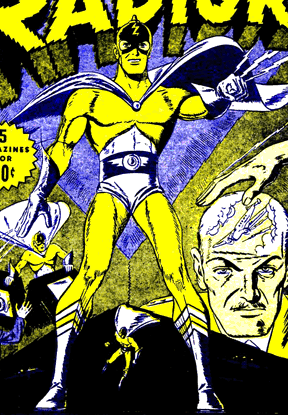
Radior: 1941, Key Ring Comics #1a or 1e (Dell). Claiming Radior is his whole name, he is the son of Professor Kennedy, the radium expert. After the Prof's wife died while the boy was an infant, I think it can be safely said the professor went a little nuts. He raised and taught the boy but also fed him liquid radium and bombarded him with radium radiation. Luckily, instead of killing him, it gave the young man vast powers. He has physical strength to handle an excess of 2000 lbs, electromagnetic powers that can make a car fly (he doesn't seem able to fly himself though), able to withstand being stabbed and vast electrical shocks, fire destructives energy bursts, x-ray vision, able to see and hear over vast distances, and with a touch, enable others to see and hear the same. A drawback seems to be that when he uses his powers it can disrupt nearby electronic equipment such as radios. He first comes to public eye when saboteur Dr. Teufel is causing planes to wreck as well as kidnapping the pilots and a sister of a pilot, Arlene Loughran to hold as hostage. He shows up at the camp as a recruit, but he's at first written off as a dangerous nut due to his vast strength. Eventually, he is able to meet the Colonel and win him over in order to investigate the acts of sabotage. By adventure's end, he seems destined for big jobs in Washington and he seems smitten with Arlene as he claims he's already picked out his secretary. Radior is not above killing his foes. He throws the villain's agent Operator 4 against a deadly electrical fence and he melts the tower that Dr. Teufel has fled to the top of, surrounding him with flame and presumably burning him alive. Note: An interesting comic, especially considering the early date for an atomic hero. The limited and bizarre color scheme (blue, black and yellow, with blues replacing about 75% of the areas where there should be black) though probably helped to insure this hero would not be wildly known. |
|
Rag-man: 1941, Catman #1 (Holyoke). Jay Garson, Jr is a reporter for The Sentinel as well as a millionaire. His articles get him targeted by criminals, but they kill a bum by accident. Realizing that he and the bum bear an uncanny likeness, he switches clothes with him and thus the Rag-man is born.He has no powers but wears a patched up suit and hat as his costume. In at least one issue, he is wearing a bulletproof vest of finely woven steel that barely saves him from mortal harm. He's assisted in his mission by his man Tiny, a powerful African who was in his employ. Tiny talks with an uneducated slang and calls Rag-man "boss", but most of the time he's not drawn in any caricature manner nor played for laughs, but presented as a straightforward African American, wearing a suit and as capable as any sidekick, sometimes moreso. He seems to backslide a bit whenever the case involves ghosts and such. Rag-man's name often switches being hyphenated or combined. The earlier issues seem to prefer hyphenated for him and Cat-man while the later issues have a tendency to combine them.. Rag-man is built upon a similar premise as the Spirit in that he lets the world think he's dead. However, he is only occassionally shown with a mask and in the first story sends in an article after his supposed death. He keeps Tiny as an assistant, but people only recognize or identify him as Rag-man without mention of Jay Garson. Like his fellow Cat-man comics star the Deacon, it is as if his previous life is easily forgotten and people readily accept the hero in their midst who seemingly has no outside real life anymore. In the later stories, his clothes are more often not patched or ragged and he has an executive office at the newspaper that he was once a reporter as if everyone just now knows or has always known since near the beginning that Jay Garson and the Rag-man are one and the same. |
|
|
Rainbow: 1941,
The Arrow #3 (Centaur).College graduate, Jim Travis announces to
his girlfriend Elsie Norris that he's been inspired by the comic
book heroes and how they fight crime and that he's going to become
one himself. She dismisses it as a "wild dream" and tells him, "but
you've got to have a costume, and you've got to be a he man." His
mind made up, Jim announces, "I'll get the costume and I'll be the
best he man the comics ever saw!" So, naturally he scrounges up
a very colorful costume and comes up with the awe inspiring name
"Rainbow". Despite all of this, he quickly finds some gangsters
headed up by Black Rufus, foils their kidnapping scheme and outfights
them. From his prison cell, Black Rufus swears revenge. |
| |
Rainbow Boy: 1942, Reg'lar Fellers Heroic Comics #14 (Eastern Color
Printing). He's Jack Walton, member of a group of youths heard weekly over a national radio program answering quiz questions known as the Wizard Kids. He's also an outstanding athlete and gained his powers while experimenting with light in his home laboratory. Beth Ryan is one of the kids on the radio program. He can use his rainbows also to blind people, fly at superspeeds to be almost invisible and he is able to see beyond the normal isible spectrum. When he flies, he leaves a rainbow tail behind him. He's able to mold that rainbow into solid shapes for use such as wrapping up a bunch of crooks (similar to Music Master and his music notes). |
| |
"Tex" Rainger: 1942, Rangers of Freedom #4 (Fiction House). The youth Tex is son of Texas Ranger "Ace" Rainger. On his deathbed, Ace has Tex take his saddle and guns but never to kill, that a man could not be judge and jury. He rides his horse Calico to bring law and order to Texas but only shoots to wound. He's soon joined by Jackie Taylor who he mistakenly believes to be a boy. |
| |
Don Rance: 1940, Detective Eye #2 (Centaur). American Don Rance is on a hunting trip in India where he saves the life of an old man being attacked by a tiger. In gratitude, the old man gives Don a magic cape with the provision that he goes out and does good with it. Don is trusted to hand deliver some documents from the American embassy in London to Washington on his way back. However, the pilot is in service with enemy powers and the documents are taken from him to be delivered to the enemy. Don uses the cape to retrieve the documents, fight a bunch of men, and help the allies shoot down an enemy zeppelin. The cape is referred to as the Mysticape. It is unclear if it imparts any abilities other than flying as most of what he does, your average two-fisted daring hero could accomplish. Or, the cape could bestow: super-strength (able to easily fight off a group of men), super senses (able to spot a submarine from a great distance), hypnotism/mind control (the enemy agent readily answers any question Rance puts to him and later he is able to pass himself off as the spy even though he is wearing a standard suit and red cape, with an aviator's cap as the only disguise element). |
|
|
Lance
Rand: 1941, Cat-Man Comics #1 (Holyoke). Lance is an extremely
capable soldier-of-fortune, aided by his pal Tubby who is only so-so
capable as is the wont of sidekicks. He also has a super-sub |
| |
Buck Ranger: 1946, Thrilling Comics #72 (Better). Buck Ranger is a cowboy hero of the Old West. |
| |
Rangers of Freedom: 1941, Rangers Comics #1 (Fiction House). The costumed Rangers
of Freedom are Percy Cabot, Biff Barkley, Tex Russell, and Gloria
Travers (as Ranger Girl) who band together to fight the Nazi menace. They had a super-villain opponent known as Super-Brain.
In issue #5, they don more traditional uniforms and meet up with Captain Morgan and his band of Marines behind enemy lines on the Malayan peninsula. Also with Captain Morgan is his #2 man John Red Hawk, an American India with all the skills that go with it and the lad Peter Morgan whose missionary father is killed and he's in search for his mother. Gloria aka Ranger Girl joined the Red Cross to become a nurse.
Eventually the team becomes known as U.S. Rangers. |
| |
Rango: 1949, Thrilling Comics 71 (Better). Rango is a Tarzan type who is helping out Princess Pantha
with shooting a movie. After his "son" Hiku accidentally
dies, he retreats to a hidden city to be alone in his grief.
However, when financially strapped Director/Producer Bowers
finds out from his own son that Rango is sitting on a bunch
of gold and jewels he almost kills Rango in effort to get
them and almost loses his own son in the process. For a
comic book tale, there's some nice shades of gray here,
Bowers is not an outright villain and while Rango is a bit
of the "Me Tarzan, you Jane" jungle lord found
in the movies, he is still handled with sympathy. They even
manage to allow Princess Pantha do the real-life saving
in the comic not by down-playing Rango's own prowess but
by handicapping him: in one scene he's blinded and in another,
weakened by a shoulder wound.
As
I said, I found this story interesting. The popularity of
the Tarzan movies ended up feeding back into stories. Tarzan
himself in THE LION MAN found himself impersonating an actor
playing him in a movie on location while the amnesiac actor
found himself being confused for the hero (and as he was
a natural coward, he made a shoddy real-life Tarzan). |
|
Captain Steve Ransom: 1939 Keen Detective Funnies v2#6 (Centaur). Steve is a heroic pilot adventurer. His fiance Sally and her brother and Cap's closest friend and mechanicl Slip Magee help out. At one point they broke a big spy ring. Sally is reporter for New York paper "Daily Blade". They are prone to calling him "Skipper". NOTE: In "Keen Detective Funnies", the comic was b/w where in "Fantoman" #3 it was in color. In b/w, the strip had a nice stark style full of shadows. The color robbed it of all that without really adding anything. |
|
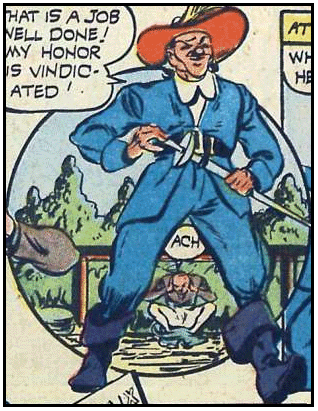
The Rapier: 1942, Weird Comics #20 (Fox). When Cyrano De Bergerac is laid low by a falling pot, a doctor friend administers an elixir to save his life. Yet, it appears not to work and he dies and is thus entombed. The elixir instead seems to have placed him into a coma-like suspended animation until he wakes up a couple centuries later in occupied France. His long sleep and physical restoration has done nothing about his heightened sensitivity over his famously grand facial protuberance and he quickly takes offense at a passing Nazi’s sneeze, thinking it a veiled insult instead of an honest sneeze. He quickly takes up with Jeanine, a friendly French lass who resembles his beloved Roxanne (she claims is the name of her great grandmother, but even that would not be enough to account for 200 years). She is also part of the Resistance. Despite the title of the strip and the next-issue caption alluding to him taking the name “The Rapier”, in-story he is simply called Cyrano. He refers to his trusted rapier a couple of times, but nothing to warrant it to be “The” rapier the title refers to. This is the last issue of Weird Comics and his only appearance. |
|
Raven: 1940, Sure-Fire Comics #1 (Ace). Police Detective Sgt. Danny
Dartin is also the Raven who preys on criminals and redistributes their ill-gotten gains among the needy and downtrodden with the help of his (adult for once) assistant
Mike. As such, he is also hunted by the police. His girlfriend is Lola Lash,
the daughter of the Chief of Police. Eventually, she seems to be in on the Raven's double life and works as an agent for him. The Raven is basically a comic version
of Frederick C. Davis' excellent Moon Man short stories also published by Ace with just the names of the characters changed and the look of the masked hero, of course. |
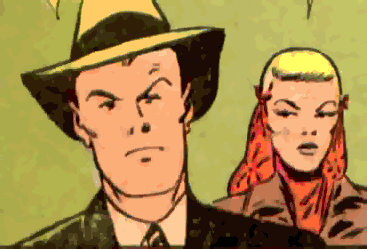 |
Rick Rawson: 1947, X-Venture #1 (Victory Magazine). Rick Rawson and Laura Brown are rival reporters for the same paper, The Daily Press. They engage in witty back and forth, seemingly involved in a love-hate relationship. In addition to being a good reporter, Rick is a good fighter and detective. |
|
Rock Raymond: 1944, Captain Flight #4 (Holyoke). In the year 25000, Lt. Rock Raymond flies the space between planets, undertaking military and non-military missions. On a military mission to Venus, he decides to also transport Janice who is looking for her missing father. Janice soon proves to be capable of pulling her own weight. |
| |
Dan Read. 1937, Star Comics #2 (Chesler) Dan Read and pal Curly Davis are adventurers and explorers of the "River of Death", aka the Amazon, looking for a lost city. What they find instead are that explorer Major Rankin and his daughter Gloria have been captured and the rest of the party killed by belligerant natives. The plucky duo are soon captured themselves, and are only freed when the natives set fire to a crate that Curly had insisted on carrying, a crate of fireworks! |
|
Reckoner: 1944, Catman Comics #25 (Holyoke). Taxi driver Michael Shawn puts on top hat and tux to investigate crimes as the dapper Reckoner alongside his boy sidekick Chipper, who doesn't wear fancy clothes or costume. In his origin story he's named as Matty Martin, by issue 27, he was already going by Michael Shawn. |
| |
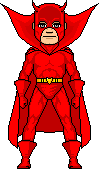
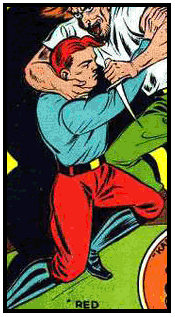
Red Ann: 1948, The Black Terror #24 (Standard). "A ruthless murder turned her life into a nightmare of tormenting passions! Vengeance drove her into underworld byways where no woman had ever ventured before! But with the help of the Terror Twins, she found her way to life again!" Five years earlier, she was happily married to a man named Bart. Not married long, he was brutally murdered by a gang at the orders of a man called the Voice. She devoted her life to hunting this criminal mastermind down and killing him. When she, with the Black Terror and Tim do track down the Voice, he's revealed as Trent, a rival suitor who had been in love with her. She finds herself as unable to kill him though and lets him be arrested. She retires as Red Ann, looking to enjoy life again, possibly in the arms of infatuated reporter Dick Reagan of the Daily Star. |
| |
Red Avenger: 1936, The Comics Magazine Funny Pages #3 (Centaur), later just Funny Pages. Don't have any info on this strip or character but it ran for several issues of this early comic mag. |
| |
Red Blaze: 1940, Fantoman #4 (Centaur). While the artwork has a tendancy to portray him as a red-head and he has a foster-father, the dialogue refers to him looking like an Indian. He's an All-American athlete in college when he is summoned back home to Nevada where his foster father has been murdered. As this is a golden-age comic, the American West is still like the Old West. He tracks the killers West through the desert towards an almost mythical outlaw town of Boomburg. Once there, he proves himself to the local sheriff and is deputized. In addition to being good at tracking and detecting and an excellent athlete and fighter, his punches can set things on fire, a trick from his tribe. Although, the man he punched, the fire didn't seem to hurt him any other than surprise him, so it may be more a visual trick. As the story I had access to was incomplete, not sure if there were other fire powers or if that was the extent of it. |
|
Red Blazer: 1941, Pocket Comics #1 (Harvey). Cowboy Jack Dawson is the unwitting subject
of a bizarre scientific process by Dr. Morgan who had spent the past four decades on Mars. Dawson is basically drugged and then sent on a pre-programmed automatic space flight that exposes him to space rays. He wakes up, his body super-charged with "Astro Pyro Rays" as well as evolved into the perfect man (which includes losing his Western accent and gaining a skimpy superhero outfit). With his now incredible intellect he reasons that Dr. Morgan wants him to go out and fight crime. Not to be confused (though often is) with Captain Red Blazer also by Harvey Comics. |
|
Red Comet: 1940, Planet Comics #1 (Fiction House). The Red Comet ,among other heroes of Fiction line, is not treated consistently during his run. In some he's a standard Flash Gordon riff, in others he is crossed with Superman and has incredible super-human strength and various mental abilities. |
|
|
Red
Cross: 1942, Captain Aero #8 (Holyoke). Not to be confused with
his spirtual brother Captain Red Cross, medical doctor Captain Peter
Hall of the U.S. Army puts on a costume to fight the enemy and protect
the victims when just saving lives as a doctor wasn't enough. Even
his nurse Lucy Feller wasn't aware of his dual role. He managed
to be fairly successful, serving in both identities in various areas
of the War, his adventures chronicled up to 1946, issue #25. |
|
Red Demon: 1946/47 Black Cat #4 (Harvey). Judge Straight is also the costumed Red Demon to fight for justice when the Law is not enough. |
|
Red Dragon: 1943, Super Magician Comics #8 (Street & Smith). After his parents are killed by the Japanese, young Bob Reed swears vengeance and studies ancient magic. Still a teenager, he sets out to wage war against the Japanese in the Pacific theatre using his powers. He's helped by his Chinese friend Ching Foo and a pet komodo dragon. His stories tended to be more
jingoistic than most magician strips, as one might expect with its focus on the War. |
| |
Red Hawk: 1944, Blazing Comics #1 (Enwill Publishing). Major Red Hawk
is a free lance Native American pilot liking to volunteer for dangerous missions. Besides a crack pilot, he's good at disguising himself, especially as Japanese. In the comics, he was stereotypically drawn as flying his plane not in pilot garb but bare-chested, buckskin pants and a headband with a feather. He was also jingo-istically anti-Japanese, common for many War strips. He made the cover for issue 6. |
| |
Red Knight: 1940, by Register and Tribune Syndicate. Dr. Van Lear uses
chemical "Plus Power" to turn his nameless subject into a superhero. The Knight
is armored from the waist up, is super strong and can turn invisible. He must
recharge his powers periodically though. |
| |
Red Knight II: 1940, Cyclone Comics #1 (Holyoke).
"Sir Miles of Lorraine, a young prince who has been robbed of his ducky by his uncle Sir Baldric, leaves his homeland to seek his fortune. He joins the army of Godefrey of Bouillon, one of the great leaders of the First Crusade to recapture the Holy Land from the infidels." He wears red chainmail armor, distinguishing him from the others. |
| |
Red Man of the Rockies: 1939, Star Ranger Comics v2 #5? (Centaur). Red Man is a Native American in what looks to be the Old West but hardly conclusive in the one story I read. He's the last of an ancient tribe and through secret knowledge, has above normal sight, strength, and even "character and foreknowledge". He also is privy to secrets of natural medicinal herbs and treatments and can throw a hatchet with enough strength to shatter a gun. |
| |
Red Mask: 1936 or 39 or 40, Best Comics (Better). The confusion over
the date is that Best Comics starting in "39 was a reprint book of work published
in 1936. The Red Mask is a safari guide in the
South Pacific. When evil is afoot, he puts on a simple red domino mask to hide his identity while he goes into action. The story in which I've seen, the Red Mask has all of the appearances of being a native (or at the least, very deeply tanned), although the cover gives the impression he's a white man. There are a few instances in comics where characters started off as a minority and in later issues became caucasian. The most famous being the jungle hero Voodah. |
| |
Red Mask (II): 1951, Tim Holt #20 (Magazine Enterprises). This Red Mask
kept order in the old west helped out by girlfriend Black Phantom. In addition
to his six-shooters, he used a lariat, bolo, and a crossbow with a grappling
hook.�In reality, he is Easterner Tim Holt (based on the B-Western actor) who adopts the identity of the legendary Red Mask from a century ago in order to defeat the local bandit leader, El Terror. Discovering he is quite good at the Lone Ranger bit, he stays in the Old West using his six-guns to fight the bad guys. |
|
Red Panther: 1940, Jungle Comics #2 (Fiction House). The Red Panther
is a costumed Tarzan type. He's never given a real name or origin story other than his mission to protect the peoples of the jungle. He did have two distinctly different costumes. The later Congo Raider appears to be the same character only re-colored. |
| |
Red Reeves: 1940, Silver Streak Comics #1 (Lev Gleason). Red is your average American boy until he meets a genie and is given magic powers.
Of course, he uses them for good and takes a bite out of crime. |
| |
Red Riot: 1945, Red Circle Comics #1 (Enwil/Rural). Red-headed Jack Chandler is Red, a professional trouble shooter for lumber camps. His friend Jake is an older lumberjack. |
|
Red
Roberts, the Electro Man: 1940, Rocket Comics #1 (Hillman).
Got his electrical powers much the same way that Pyroman did, he
was framed for a crime and sent to the electric chair, here it was
a mixture between his straining against his bonds while being electrocuted.
In addition to the standard electric powers, Red could become pure
electricity and thus be invisible and travel and transmit over powerlines
and cables. Unlike Pyroman, he didn't wear a special costume. |
|
|
Red
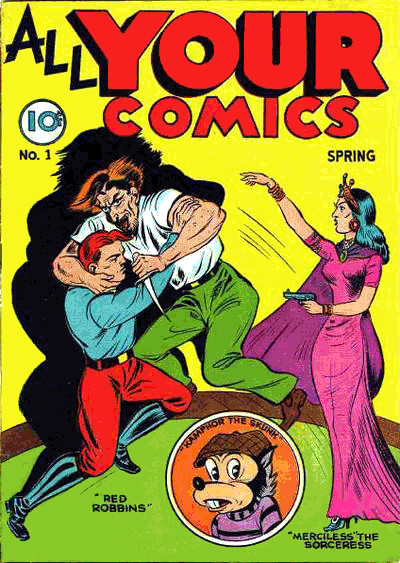
Robbins: 1944, All Top Comics #nn (Fox). Red Robbins is "the
fastest man in the world." and he "never uses a gun and never
kills! His socks are like bolts of lightning so that he knocks the
enemies of America unconscious." His first foe is "Reltih",
spell it backwards... Soonafter, he teams up with an African American
young man by the name of "Speed" Karr. Speed is under
the delustion he has superspeed as well when in reality he has the
dubious "power of slow motion". The adventure I read from
All Good Comics, the colors of his shirt and pants are reversed
from what's shown as well as the pants being jodhpurs. The cover of All Your Comics implies a crossing of swords with Merciless the Sorceress. In his first story, Red doesn't appear to have any superpowers but is a famed pilot.
|
|
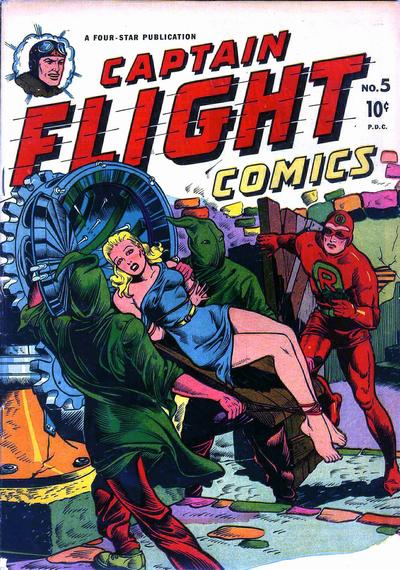
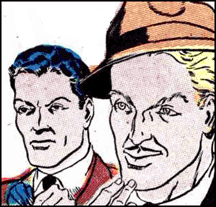
Red Rocket: 1944, Captain Flight Comics #5 (Four Star). In his first appearance, his story is set in the present day. There, the Red Rocket is Rod Page. Along with his pal Punchy, he solves crimes showing Sherlock Holmes style of deductive reasoning. His costume looks like the Blue Beetle's, only red chainmail instead of blue. Although the effectiveness of a costume and masked identity is questionable when your side-kick wears street clothes and no mask.
At least by 9th issue the adventure became a sci-fi strip with it being in the future, and Red Rocket flying a spaceship, keeping the peace between the planets. The year being 2042 is established in issue 10, and 2046 in 11.
Rod & Punch
|
|
|
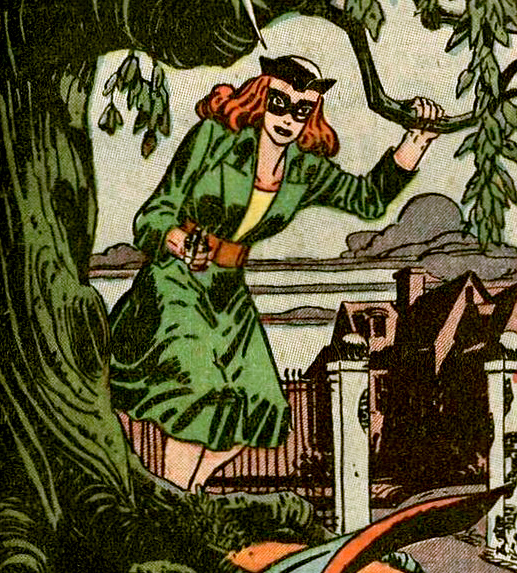
Red Rogue: 1945,
Star Studded Comics #NN (Cambridge). Private detective Rod Rooney
has built a reputation for solving impossible and bizarre crimes
to the consternation of the police he keeps showing up. The more
bizarre crimes, he investigates as the masked hero, the Red Rogue. |
|
|
Red Rover: 1943, Red Dragon Comics #5 (Street & Smith).The
Red Rover is a legendary heroic figure of the night who through
the ages aids the downtrodden and the weak, reappearing each century.
Least that's how the story goes and young Jimmy Rover wishes he
could be like the Red Rover. Little does he know, he's about to
learn, beware what you wish for... As he goes to meet his parents
at the touristy/ amusment spot the Devil's Cavern, he rescues
a mysterious old man who gives him a ring to protect in secret.
Jimmy is elated, thinking that the Red Rover had a ring, although
this is only half a ring, part of it missing.
At the caverns Jimmy gets separated from his parents and the
rest of the group and finds a chest with a costume and the other
half of the ring. When he combines the ring he becomes invigorated
and the modern day Red Rover!
However, tragedy strikes. While missing, his parents and others
of the group are killed by man-sized bats and a red devil, the
guide is the only one able to flee to the surface to tell the
tale. RR secretly investigates along with the police. He unmasks
them as bootleggers headed up by Banker Bones who were using the
caves for running pipes and stealing gasoline from a local company
and needed to shut down the tours. In the origin story, other
than being very good in a fight, Jimmy doesn't show any obvious
super powers. |
| |
Bart Regan: 1936, The Comics Magazine #2 (Comics Magazine Company). Bart Regan is a federal agent and spy. While debuting here, he next appeared at DC in Detective Comics #1 where he'd regularly run. |
| |
Paul Revere, Jr.: 1941, Banner #3 (Ace Periodicals). Paul Revere, Jr. is a boy in New York City who is friends with the likewise improbably named Betsy Ross and
Patrick Henry. The trio get into all sorts of adventures. This isn't as strange as it sounds in that it was common practice with dime novels and such to feature such heroes as Tom Edison, Jr. The three kids head up "America Awake Club", a club of patriotic kids named after the column that Revere's father writes. As such, their clothes are embroidered with "AA", be it a vest, t-shirt or dress. |
| |
The Researcher: 1940, Green Giant #1 (Pelican). The Researcher is called this by all his friends, so his real name is unrevealed. He's a talented young scientist, his assistant is Paula who'd like to marry him. He has as a friend the older bachelor Dr. Revel and his servant Wun. He feels his inventions are for aiding humanity and thus unlike Dr. Nerod in the same title, does not present his inventions to the army and turns down solicitations to work for the War Department. Among the things the Researcher has invented that helps him unravel interesting adventures he manages to get into are a Psycho-Ray (a machine that projects thoughts on a television screen), an x-ray flashlight that allows him to see through walls it shines upon, a walking stick that is really a paralysis ray gun, a televisor that allows him to view things remotely, and a machine with power rays that allows him to take over by remote control other vehicles. Drawn by the wonderful Frank Thomas. |
| |
Rex: 1940, The Funnies #45 (Dell). Rex is the "King of the Deep," designer, builder, and captain of his own super-submarine.Rex has a super-sub. His friend Tim also mans a submarine. Both have their own complement of sailors and weaponry. He eventually picks up a young stowaway named Butch.
He is also helped by girlfriend Nan Barlow. |
| |
Ace Reynolds: 1944, Captain Flight #1 (Four Star). Ace is forced to drop out of school and get a job as bill collector for "The Daily Blade" but has aspirations to be a reporter. Through some bad and good fortune and a bit of initiative, he finds his dreams come true as he reports a firsthand account of a ship being struck by a German U-boat. After that, he's constantly falling in and out of spy plots and reporting them. In most adventures he's a blond, but a few has him with dark hair suggesting originally meant for another character. |
| |
Dusty Rhodes: 1947, Joe Palooka Comics #15 (Harvey). In the year 1946, red-headed boy scientist Dusty Rhodes is fooling around with some chemicals and the resulting explosion sends him to the year 2446. Atoma is an historian and tells him that he discovered the "time element" and he'd write about it and his adventures in the future in his memoirs when he got back to his own time. She shows him the City of Peace, covered by an atomic bomb proof dome that keeps the temperature an even 72.6 degrees, how they have large humanoid robots that are mobile atomic energy plants, that machines and such have made life so efficient, people only work an hour a day. Likewise people can live for centuries, 250 years old is considered young-ish, but when they get that old, apparently they can just disintegrate or fall apart at any time. Things aren't perfect though, as only a few people actually have freedom, the governor is a tyrant "like Hitler". Dusty is also good with a sling-shot, using one to bring down one of the atomic robots that starts to run amok. |
| |
Jack Rhodes: 1939, Amazing-Man Comics #5 (Centaur). Rhodes is some type of investigator. In his one published case, he stopped a crew using a submarine in a river for smuggling in supplies picked up in international waters, bypassing customs and such. Rhodes is an able pilot and diver. NOTE: Some sources list Rhodes as being Minimidget, but this comic had individual stories with both characters and Minimidget's real name was unrevealed. |
| |
Rick Richards: 1947, Blue Bolt Comics v7 #8 (Novelty). Rick is heir to the Richards fortune. He's also a two-fisted type helping others out and sticking his nose into all sorts of trouble. What makes him a bit unique is that he has unique glands, a sudden loud noise alone can trigger temporary above average strength and endurance, allowing him to burst rope bonds and such. |
| |
The Rider of the Painted Stallion: 1937, The Painted Stallion (Republic). Dennis Durrant writes: "The Rider of the Painted Stallion is the title character of the 12-episode Republic serial The Painted Stallion, one of the studio's earlier efforts. The Rider patrols the old west hoping to bring peace between the peoples there. To that end, she rides a painted stallion on a quest for justice. She helps the wagon train bringing a peace treaty between American and Mexico to Santa Fe for the incoming governor to sign. Clark Stuart, the man bringing the treaty is on the train, and the acting governor, Alfredo Dupray, tries to stop him from getting there. She has some authority over the Cherokee tribes in the area, and when they are goaded by Dupray's men into attacking the wagon train, she fires a whistling arrow at them and then gestures to them to leave the area by gesturing away from her body with her bow. This is how she mainly communicates to Stuart and the other heroes in the train, because - as it turns out - she speaks only in the language of the Cherokee. Once Dupray is finally killed and the treaty signed, the men wonder who the rider is and the governor speaks of a girl who was the sole survivor of a raid on the fortress where her family was living. Enchanted by her blonde hair, the Cherokee worshipped the baby girl as a goddess. They raised her with only one purpose in mind: to bring peace to the people of the Wild West. In the end the Rider goes off with Stuart to further adventures. The serial came out in 1937, well before the character called Firehair was invented, making her the first Western heroine to be brought up by a Native American tribe." NOTE: I don't normally include the many serial heroes but this one does have some points of interest such as an early mystery hero that is a woman and also featuring as a character none other than Davy Crockett. It starred serial actor Roy "Crash" Corrigan and early Western star Hoot Gibson. |
| |
Red Riley: 1941, Liberty Scouts #3 (Centaur). Red Riley is
a tough as nails cop of the River and Harbor Patrol. He's good in a fight, able to hold his own against several men at once. |
| |
Rio Kid: 1940, Thrilling Comics #2 (Better). Texan Captain Robert Pryor, calvary hero of the recent Civil War, is better known as the hero the Rio Kid in the American West. In addition to his comic run, he had a very successful run as a pulp hero where the above info came from. |
| |
Rod Rion: 1935 Rod Rian of the Sky Police newspaper strip (The George Matthew Adams Service, Inc.); 1938, The Comics (Dell). In the future, Rod is a member of the Sky Police fighting space pirates and having Flash Gordon like adventures. Commandant Elmus is his boss. On a distant planet, he and his girlfriend Karin run afoul of an alien despot aptly named Mephistos and his Mephisians (bald red men with pointed ears). He befriends Taro, a lieutenant of Unicor warriors, who look similarly to the Mephisians only they have hair and a single horn growing out of their forehead and are enemies of Mephistos. In some ways they seem Stone or Iron age, clothed in skins and carrying lances and shields. However, they also have flame guns, and Projectil-Planes which can fly through space. They take the fight to Mephistos' home planet and his skeleton men (something in the water makes flesh transparent). |
| |
Rod Ripley: 1943, Blue Beetle #27 (Holyoke). A mysterious disease is ravaging humanity and a world famous laboratory commissions a wizard of science, Rod Ripley to discover the cure. His search takes him to Cairo in search of the "lost formula of Rameses." With a small group consisting of Ripley, his assistant/girlfriend Zarita, Sir Balcolm, and Arab guides led by Ahmed, they make their way to the pyramid. Ahmed is killed and the guides leave with his body. The trio find Rameses sarcophagus and open it to get the formula which awakens the mummy of the pharaoh who curses them. Sir Balcom falls unconscious but the goddess Isis appears and allows them to leave with the formula as long as they seal up the tomb behind them which they do. And, this was all in just one issue. |
| |
Tim Roberts: 1940, Masked Marvel #1 (Centaur). Tim Roberts is a boy explorer along the lines of Johnny Quest. His father is a professor while Ken Masters provides the muscle. They steal Nahapatan, a golden idol from a lost race Aztec tribe. Despite this being presumably somewhere in central Mexico, they encounter a tiger in the jungle. |
| |
Robin
Hood: 1942, Green Hornet
Comics #7 (Harvey). Brilliant doctor and surgeon Dr. Fairbanks is
moved by the amount of crime in the city and with his valet Tuck
and truck driver "Big John" Sherwood who is a victim of
crime, he organizes and inspires them to follow him as Robin Hood
and his men. Fairbanks' nurse Elaine Barton is unaware of Fairbanks'
dual identity and of course wishes he could be a little more like
the hero. |
| |
"Robin Hood" Jones: 1940, Champion Comics #6 (Small Press/Harvey). A small band of high class hobos fight for justice of the common man and merchant. Robin Hood is the leader and his two pals are the tall husky "Little Jack" Lee and the portly "Fry" Tucker. Robin Hood is good in a fight and even talented with a boomerang. Fry's specialty appears to be throwing horse shoes. |
| |
"Mob Buster" Robinson: 1939, Wonderworld Comics #3 (Fox). Robinson is the crime-busting DA of Capitol City. |
| |
Robo: 1940, Cyclone Comics #2 (Bilbara Publications). Android of the
little people. |
| |
Inspector Roc: 1947, Blue Beetle #45 (Fox). Inspector Roc is a pipe smoking detective, solving cases in one page mysteries titled "Inspector Roc's Felony Files". |
|
|
Rocket
Boy:1942, Scoop Comics #2 (Harry "A' Chesler). "Determined
to seek out and learn the truth of his father's strange disappearance
in the jungle of Africa, Billy Woods, husky little Rocketboy, braves
the Dark Continent with grim determination to solve the mystery."
As Rocket Boy (the name is clearly two words in the title, but spelt
as one throughout the story) red-headed Billy wears a red and yellow
outfit with small rockets on his back. He does find his father, who had been captured by a gang to force him to give up the details to a diamond mine. Don't know if it was ever explained where the jetpack came from, the story implies that he was Rocketboy before his father's disappearance. |
| |
Rocket Boys: 1940, The Funnies #49 (Dell). Frank Blade and Mac Harmon are kidnapped from Earth by a seven foot tall stranger who forces them onto a rocketship and takes them to the distant planet Platura. The two boys lead a mutiny with two natives (Lanor, the scientist and his son Karim, both giants themselves) against their captors and are now rocketing through space. |
| |
Rocket Riley: 1940, Rocket Comics #1(Hillman) . Provessor Sterling is an internationally famous scientist experimenting with interplanetary rocket ships and Rocket is the Professor's assistant and pilot. He's also engaged to Griselda, the professor's daughter. They have to contend with Von Stengle, head of an international spy ring who wants the professor's inventions. |
| |
Rocketman: 1941, Scoop Comics #1 (Harry "A' Chesler). Inventor Cal Martin creates a rocket pack that allows him to jet through the air. He builds one for himself and his girlfriend Doris Dalton; together they fight crime and the Germans as Rocketman and
Rocketgirl in matching costumes. In Punch Comics, Cal's job was that of an attorney. NOTE: When reprinted, Rocketman and Rocketgirl's costumes were
colored differently and their id's were changed to "Tech' Carson and Pat. |
| |
Rocketman II: 1949, King of the Rocketmen (movie serial). Despite the name,
other than his scientist friend subbing for him one time, there's only one Rocketman,
whose name happens to be King. Jeff King. King is after the insidious Dr. Vulcan. |
| |
Rocky X: 1952, Boy Comics 80 (Lev Gleason). FBI agent William Rockwell
is assigned to protect Dr. Frank Liebert as he builds the first moon rocket.
Upon its completion, he is inducted into the Rocketeers, newly formed by the
UN to explore space, and given the name Rocky X. In issue 100, he goes back
to being just an FBI agent. |
| |
Bill Rodman: 1936, Funny Picture Stories #3 (Comics Magazine Company). Bill Rodman and Tom Norton are newsreel reporters/cameramen out of New York. The are sent aboard The Sea Wolf to cover a war. They instead come between the skipper and some mutineers, find themselves set adrift, and end up filming some fighting involving Chinese troops. They are almost shot if not for the intervention of an old friend, General Fong. The general arranges for them to fly to Hong Kong and they get some more action film shots along the way. |
| |
Red Rogers: 1942, Devil Dogs Comics #1 (Street & Smith). Red is of the Rangers and part of the invasion of the Belgian Coast. NOTE: Written by Walt Gibson and drawn by Jack Binder. While the comic takes its name from the Marines, two of the strips reference the Army Rangers. |
| |
Runaway Ronson: 1940, Blue Bolt #1 (Novelty). Runaway Ronson is
what is called a "stream engineer," an engineer of the Rocket, a super-train. |
| |
Private Rook: 1941, Army & Navy Comics #1 (Street & Smith). Private
Rook is a heroic buck private still in basic. |
| |
Rocket Rooney: 1940, Bill Barnes Comics #1 (Street & Smith). Rocket is a jack of all trades in the future: spaceship pilot, scientist, explorer and handy in a fight. He and his best pal Professor Watts of the Technical Research Bureau have various Flash Gordon/Buck Rogers type of adventurers.
|
| |
Randall Ross: 1941,
The Arrow #3 (Centaur). Ross is a plainclothes detective and master sleuth. In addition to carrying a gun, he keeps a switch knife strapped to his wrist in cases of emergencies, such as cutting through ropes when tied up. He's also schooled in the art of Jiu-Jitsu. |
| |
Dick Royce: 1945, Witty Comics #2 (Chicago Nite Life News). Dick is a two fisted pilot. He is in Africa trying to convince some natives to sell their land for airstrips while some gangsters have arrived to search for the fabled elephant graveyards. He saves a missionary from them and meets his redhead daughter Ricki. However, the witch doctor teams up with the gangsters and while Royce and Rickie are riding an elephant through the lands, the crooks kill the chief and her father. Once the witch doctor shows them where the graveyards are, they kill him too. One dies fighting Royce who knocks him off the cliff. The other two die when they steal Royce's plane which the witch doctor had tampered with earlier and it crashes. For his bravery and sincerity, the chief agrees to sell the land to the airline as long as Dick agrees to stay and defend the village and tribe's lands. I am assuming this is the first chief's son, though both are named King Mula |
| |
Rex Royce: 1941,
Whirlwind Comics #1 (Nita). Rex Royce is one of the finest Royal
Canadian Mounties keeping peace in the frigid far north. |
| |
Royal Watch: 1941, Ranger Comics #1 (Fiction). The Royal Watch are made up of RAF hero Jock Macgregor and three lads: Terry, Mac, and Harry (Cockney, Australian, and Canadian though possibly not in that order). |
| |
Rulah the Jungle Goddess: 1947, Zoot Comics #7 (Fox). Jane
Dodge is a rich American orphan bored with the rich life. While out flying her plane
crashes in the African jungles. Stranded and left in rags, she takes to wearing animal skins and becomes the jungle queen Rulah, finding the excitement that civilized life was lacking. She has an abnormally intelligent pet panther named Saber. |
| |
Rurik: 1941, Spitfire Comics #1 (Harvey). Rurik is a Danish King in the times of the Vikings. He, his right-hand man Reith and crew sail the seas in search of a life of adventure. Their travels even take him to discovering a hidden land in the frozen North. |
| |
Reff Ryan: 1941, Planet Comics #13 (Fiction House). Fearless explorer of space from Earth. In issue #26, he teams up with the space man Flint Baker and become part of the crack team of Space Rangers commanded by Borla, the Martian. |
| |
Rocky Ryan: 1940, Big Shot Comics #1 (Columbia). Rocky Ryan is a "free-lance adventurer" and explorer and does his adventuring helping out the British in India. He also discovers Pola, an underground Antarctic city, lands in another dimension and so on. Girlfriend, fellow explorer and archaeologist is Doe Ames, who is quite capable in her own right. Rocky is a skilled fighter whether with gun, fists or steel. Doe proves to be proficient with bow and arrow in at least one adventure. Doe's father, also an archaeologist aids them on occasion. |
| |
Rodeo Ryan: 1947, A-1 #8 (Magazine Enterprises). Jim "Rodeo" Ryan is a cowboy in the modern West though his jalopy is still a couple of decades out of date. |
|
|