| |
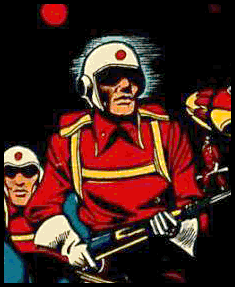
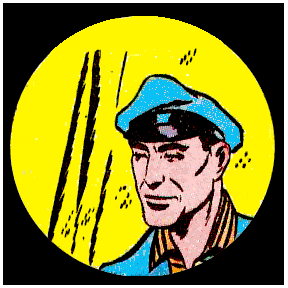
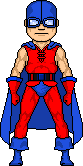
The Cadet: See "Kit Carter" |
| |
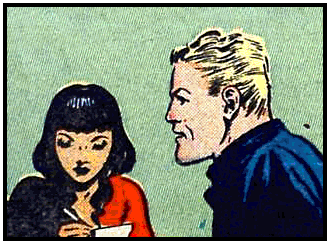
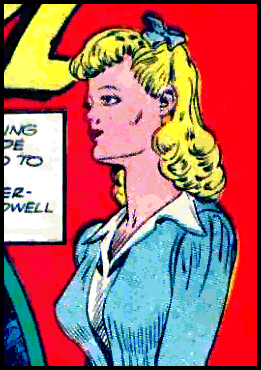
Calamity Jane: 1946, Boy Explorers #17 (Harvey). Blonde bombshell Jane Janis is a tough slang talking beautiful private detective. The ever cheerful Hack is a taxi driver that helps her out some, whether providing transportation or back-up although she hardly needs it, able to physically handle crooks herself. The creator Bill Draut inserted himself into the stories, interviewing Jane about her adventures. |
| |
Calhoun of the Air Cadets: 1942, Wings Comics #24 (Fiction House). Jeff Calhoun is from a Southern town called Blue Ridge (presumably near or in the mountain range of the same name) and speaks in stereotypical southern hillbilly dialect. Back home he flew a crop duster but with the War he wants to join the Air Corps where he's belittled as being a hillbilly. Indeed, he doesn't even to seem to be aware that the North won the Civil War. Despite this, he uses his hunting rifle and backwoods skills to fight the enemy. His hound dog is named Mournful. |
| |
Caligari: 1942, Super-Magician Comics #7. Much like Blackstone, the star of the comic, Caligari is a stage magician who gets called into solve mysteries. |
| |
Ted Cameron: 1940, Cyclone Comics #1 (Holyoke).
Son of a soldier of fortune, he picks up where his dad left off, looking for adventure in the Americas. |
|
Camilla: 1940,
Jungle Comics #1 (Fiction House). Camilla is queen of the "Lost
Empire", a white woman descended of Norsemen who found their
way to Africa during the Crusades. In the early adventures, she was portrayed as an immortal and cruel jungle queen whose people engaged in human sacrifices. Over time, this image slowly changed, ultimately with her becoming a more standard jungle heroine in animal skins. She has a wolf/dog named Fang. |
| |
Tom Campbell: 1936, Funny Picture Stories #1 (Comics Magazine Company). Tom Campbell described as a "Yank soldier of Fortune" adventures down in South America. |
| |
Candid Charlie: 1944, Target Comics #v4n9 (Novelty Press). Charles Click aka Candid Charlie is not necessarily a good fighter and has no powers, but his knowledge of photography and talent with a camera manages to serve him well in having all sorts of adventures and doing his part in the War overseas. His hometown is Lensville, of course. |
| |
Cannonball Cannon: 1941, Green Hornet Comics #6 (Temerson/Helnit/Contintental). Cannoball is a performer for the Trent Circus. However, to do his part for the War, Cannon quits the circus to join the Air Corps and uses his special skills to fight the Nazis. |
| |
Lt. Jim Cannon: 1940, Speed Comics #6 (Harvey). Commander of a Q-Boat in the British Navy, he keeps running afoul of the villainous submarine commander called the Devilfish. |
|
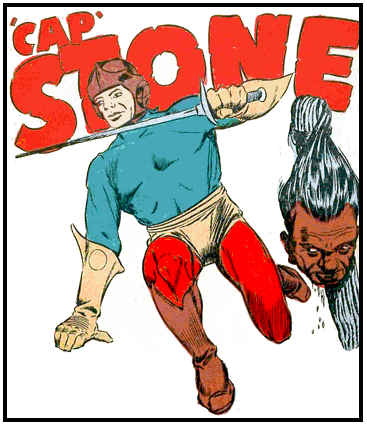
Cap Stone: 1941,
Captain Fearless #2 (Holyoke). "Cap" Stone is a marine investigator, using a helium mixture that allows him to descend to greater depths in searching out wrecks. An accident cuts him off from above and he sinks to the bottom of the ocean. He's rescued by Dhora and her father who are from a technologically undersea city/kingdom. The city exists because of an air bubble created gases given off from au undersea volcano. The special rarified air affects Captain Stone, giving him super-strength and ability to leap great distances, and possibly even flying. Dhora's infatuation with him earns him the enmity of her former suitor Triton. NOTE: Cap Stone seems to be originally intended to be a continuation of the Captain Storms strip, transforming the undersea adventurer into a superhero. Wherever Stone's name appears, there's extra space indicating that it may have meant to be the longer name. |
| |
El Capitan: 1943, Hello Pal #1 (Harvey). El Capitan is a South American Zorro type only without the mask or the all black clothes. He fights Nazis when they try to get a foothold in South America. He reports to Washington though, who sends him on this mission. He rides a black horse, uses a whip and is good with his fists. While he and those he helps use some Spanish idioms, it's not played up in a stereotypical manner so it's hard to tell if El Capitan is trying to pass himself off as a native. The Nazi agents recognize him as "El Capitan" so he has garnered some fame before this mission. NOTE: Despite the comic being put out by Harvey, the material and characters are mostly ones associated with Chesler. |
| |
Captain Aero:
Dec. 1941, Captain Aero #1 (Holyoke). An aviator hero who took on special missions in Europe and Asia on behalf of the War effort. Had a tendency to call on Lady Luck when in a tough spot. In at least one issue (#2) he is also referred to as Agent X-3. In issue #6, he gains the teen Buster Mason as a sidekick. Buster’s father was an imminent doctor captured and killed by the Nazis while in Germany on an errand of mercy. He also
is assisted by Chop Suey. He also has a special plane that seems to allow him to use his propellor like a buzz saw. |
| |
Captain Aero's Sky Scouts: Captain Aero (Holyoke). Youths Jimmy and Bobby are the flying proteges of Captain Aero and thus decent pilots and fighters in their own right. Not old enough to enlist yet, they still find themselves helping Aero in solving some cases when he's on leave from the Pacific theatre |
|
|
Captain
Battle: 1941, Silver Streak #10 (Lev Gleason). Battle was a
cross between Nick Fury and Captain America. Greying at the temples
and sporting an eye patch, he was a patriotic hero. John Battle
is a veteran of World War One, supposedly the youngest to fight in that War and lost his eye in hand-to-hand combat in Chateau Thierry. He now fights to prevent a new one occurring
(obviously he fails in that endeavor). He has a laboratory on top
of a mountain where he comes up with all sorts of inventions such
as the "curvoscope," which allows him to see anywhere on earth,
a "dissolvo gun" which disintegrates matter, a gyroscope-like "luceflyer,"
and a jetpack. Battle is the third patriotic hero (after the Shield
and Captain America) to get his own title. Sidekick is Nathan Hale,
later called Hale Battle. Jane Lorrain is his little seen secretary and who makes sure he's properly equipped for battle. |
|
|
Captain
Battle Jr.: 1943, Captain Battle Jr. #1 (Lev Gleason). Captain Battle, Jr. is described as the son of the great WWI hero and Nazi buster Captain Battle, though it's a bit unclear if meant to be the patriotic themed hero above. While young, considered a boy by commanders, he's also considered America's greatest ace. He is sidekicked by his friend Master Sergeant Sid Kaplan and the dog Victory. Victory sacrifices himself to blow up a fortress. Sid is machine gunned after parachuting out of his plane that he sacrificed to save Captain Battle, Jr's life. During the course of his mission to capture Von Teufel, he finds his father a prisoner of the Nazis and is able to eventually rescue him. His father does have an eye patch like the hero, although it is on his right eye when we first see him and on his left when he's rescued. |
|
|
Captain
Combat: 1945, Star Studded Comics #1 (Cambridge House). This
nameless man is an acrobat (claims to be pretty good too) and dressed
as a comicbook hero named "Captain Combat" on a float in a parade.
While getting ready to change to meet the woman dressed as Mother
Goose for a date, he overhears the "Santa Clause" talking other
Santas into crimes using pipes that blow poisonous bubbles. He decides
to actually fight crime as the Captain. |
| |
Captain
Courage: 1942, Punch #1 (Chesler). AKA Capt'n Courage.“A queer trick of fate and Captain Courage, burly skipper of a trans-oceanic freighter, finds himself thrown back centuries to relive the age of the bucaneers and the rovers of the Spanish main.” A storm destroys his ship and he wakes to find himself on a ship in the “Sea of Lost Ships” where time has stood still for centuries and other time-tossed sailors have arrived. Beating the hulking Bull in a fair fight, he's declared skipper of a ship and tough crew, ready to sail to fight those that have turned to piracy. Bull is made first mate. Courage looks a little more super-heroic than most with a loose blue short sleeved shirt, red trunks and calf-high boots and blue tights. |
| |
Captain Courage (II): 1946, Punch Comics #18? (Chesler). Unlike the sailor Captain who was stuck in the past, this one is present day and at loose ends after WWII. He's sent on a bombing mission to help end the War in the Pacific too. His plane gets caught in a water spout, and he's thrown around until he reaches an unknown island that holds two secret Ruritanian kingdoms. The first is Windsor Kingdom ruled by David Windsor, a man Courage knew back in college! The second is Monsonia, ruled by outlaw Rud Hagar who overthrew the legitimate rulers. David is betrothed to the Princess Electra of Monsonia. King David is killed, strafed while parachuting out of his doomed plane, but he keeps an eye out over Captain Courage and spies on the enemy while Captain Courage continues to lead King David's men in fighting the enemy. David's ghost communicates to Courage while he's asleep, giving him tactical advice so that Captain Courage is able to bomb Hagar's army. Even after victory, David's spirit lingers, continuing to give Courage advice while he sleeps, though Captain Courage doesn't know this is the source of his ideas. Rud Hagar is imprisoned, escapes, and is finally killed in hand-to-hand fight with Captain Courage. |
|
|
Captain Courageous:
1941, Banner #1 (Ace Periodicals). Captain Courageous is one of
those Ace characters with ambiguous backgrounds. He has no origin
or secret identity and generic superpowers. He appears whenever
brave people pray for courage. At the end of the War, he had given up the costume for an actual captain's uniform of the U.S. Army and didn't appear to have any powers. |
| |
Captain Crime: 1948, Crime Patrol #7 (EC). Captain Crime is a former Army man who has been all over the world and fought the Germans in the Balkans. In the United States he finds himself pitted against an old adversary, General Grimmler of the Gestapo who has now taken to crime in the States and nick-named "the Field Marshal of Murder". |
| |
Captain Curry:
1940, Amazing Adventure Funnies #1 (Centaur). Curry's a Secret Service
Agent fighting to keep America safe for you and me. |
| |
Captain Cutlass: 1946, Seven Seas Comics #1 (Leader Enterprises/Universal Phoenix Features). The English king is being counseled by evil, and sea captain Rodney Yorke is labelled as a pirate and flees the red coats hunting him and who are also trapping honest sailors into work gangs. He gets a crew that's eager to sail under a benevolent captain. His first mate is Peter Dirk, his ship “Smiling Lass”. When he leads his group to take on English soldiers who had taken over his ship with only a single cutlass to his name, he earns the moniker of “Captain Cutlass”. Sue sneaks aboard disguised as a man but is quickly found out. However, due to her education and willingness to fight, she is kept aboard. She's a redhead in the first issue, but dark-haired in the second.
|
| |
Captain Dash: 1945, Captain Flight #10 (Four Star/Ajax-Farrell). A heroic pilot/agent operating out of Kabul in the Middle East. Has a handy boy called Hadu. NOTE: A relettered Captain Flight story, he's actually referred to as Captain Flight on the final page. |
| |
Captain Death: 1940, Doc Savage Comics #1 (Street & Smith). Texas cowboy Steve Kenny is known as Captain Death because most of his foes wind up dying. |
|
|
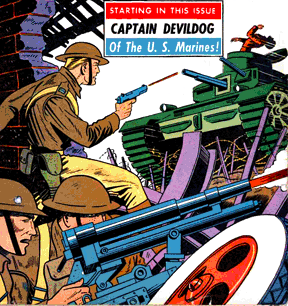
Captain Devildog:1941,
Big Shot Comics #13 (Columbia). Captain Hank Steele, known to his fellow Marines as Captain Devildog. In his first story, one of the text boxes refer to him as "Jim". |
|
Captain
Fearless: 1939, Silver Streak #1 (Lev Gleason). An adventurer with a strong sense of wanderlust. He ends up running afoul of the Chinese Ting Ling. He's sidekicked by Dugan, formerly a lieutenant of the U.S. Marines. |
|
|
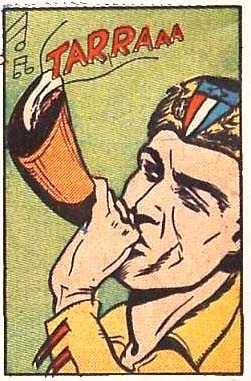
Captain
Fearless: 1941, Captain Fearless #1 (Holyoke Publishing). John
Fearless VI is visiting the grave of his Revolutionary War ancestor, the first John Fearless who died on the battlefield and ruminates on his family history of patriotism and vows to follow in their steps. No sooner are the words out of his mouth than he's visited by the ghost of his ancestor who refreshes in his mind of that very heritage and that
he is needed to fight the Axis threats that are striking inside their borders. To that
end he gives his descendent a costume and magic horn to help. Captain
Fearless has no superpowers, but the horn summons the ghost who
helps out. The ghost can fly and fight, but only John Fearless sees him. Anyone blowing on the horn will summon the ghost. Captain Fearless also takes on cases for Military Intelligence, who seems to know that John Fearless is the hero Captain Fearless and that they even recognize the rank. |
| |
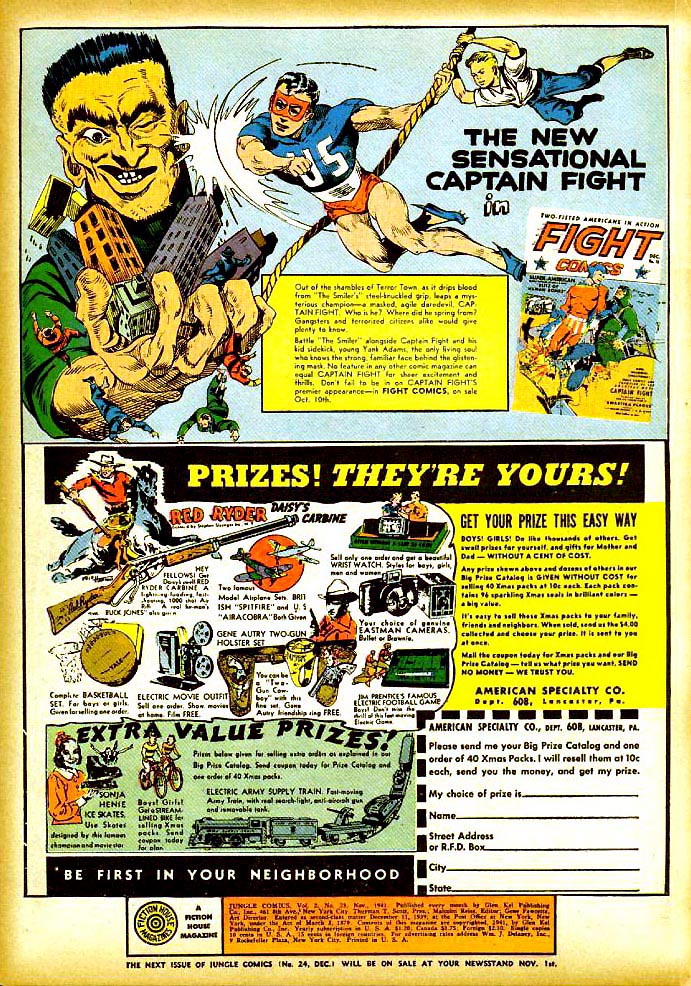
Captain
Fight: 1941, Fight Comics #16 (Fiction House). Jeff Crockett is an ace athlete and boxer with a chance to actually fight a championship bout but instead becomes a Freeville High School athletic coach. This reluctance is seen as being cowardly by his students, but it covers his activities as the patriotic clad Captain Fight. Despite this act and wearing a mask, he is still instantly recognized by his student Yank Adams which puts him ahead many other characters in the smarts department. Of course, Yank's father is a brilliant inventor so maybe that accounts for that. In his last appearance, he appears to be dating Yank's sister Beth who is a little more outspoken and into sports as well as the hero Captain Fight than would be considered proper at the time. Yank operates as a sidekick of sorts, never adopting a costume or secret identity but is very capable due to being taught how to fight by Crockett. |
| |
Captain Fight (II): 1946, Fight Comics #44 (Fiction). Framed for killing a man and looting ships, Captain Fight and his crew sail the seas. He manages at least to convince Sutton's son Rusty that he didn't kill his father and takes him aboard as a cabin boy. His ship is the Sea Scourge. |
|
|
Captain Flight:
1944, Captain Flight #1 (Four Star). Captain Flight is one of those
heroic pilots. In his first adenture, he has a sidekick in Tom, an African-American male drawn and written in a more realistic manner. He loves and is loved by Lilly Duval, a reformed spy.
In issue 4, he's a member of the Doom Squad, but it's issue 5 that reveals who they are and how he hooked up with them. At this point, Flight is described as a freelance adventurer and pilot. He accidentally discovers a hidden base. He's immediately vouched for by Jerry McGuire who had flown with his father, Major Flight, in WWI. Chief Davis is a wealthy plane manufacturer who with McGuire started the base in 1939. With trusted mechanics and staff, the place is outfitted with planes of revolutionary design, capable of 400 mph as well as developing an aerial bomb. Other fliers are also WWI aces: Dale, Parker and Akely. The Chief's daughter Elsie rounds out the group. She takes a shine to Flight (Lilly hadn't been seen since issue 2). |
|
Captain Flight II: 1947, Captain Flight #11 (Four Star). This Captain Flight is a scientist in the future, possibly around the same years as the Red Rocket of the future due to allusions to the discovery of atomic energy and the last World War being 100 years before. He has rockets and an observatory and a crew of colleagues. Five of them are Dr. Buergo, Professors Whitman, Cole, Burdick, and Farrell. Text story behind the cover. |
|
 
 
|
Captain
Freedom: 1941, Speed Comics #13 (Harvey). Newspaper publisher
Don Wright dresses up in a patriotic costume to fight the evils
of the Axis powers, frequently alongside the Young Defenders, one of the numerous child gangs of the golden age making him a cross
between S&K's Captain America and Guardian. This particular group with names like Lefty, Whitey, Slim, Beanie, Blackie were collectively known as the Young Defenders and also featured a girl among the, Joanie. As often was the case, they'd uncover some crime or plot, get in trouble and word would get to Wright who'd put on his costume, rescue them and the group would clean house. In his first appearance, he operates alone and seems to possess some limited super-strength and invulnerability (he jumps off a building onto a car, wrecking it, later survives a car crash without a scratch that kills an enemy agent) though susceptible to gas. It should be noted, at this point, Speed was not published by Harvey and the various costumed characters would get significant revisions when Harvey takes over in just the following issue.
In an interesting little text story in issue #26, 1943, Captain Freedom is part of an invasion force, heading into Germany, forcing their surrender. Hitler commits suicide over capture. The story also reveals that he keeps a specially designed plane in a secret hanger underneath an orchard on his estate. He designed and built the plane himself, and it's able to do over 700 mph, getting him to Europe in no time.
Unlike many of the patriotic heroes, Captain Freedom's career managed to outlast the war, his final adventure in issue #44, 1947. A decent achievement, especially in those times for a patriotic themed superhero.
He became the cover star with issue 16, appearing on every cover after that, some in adventures with his co-stars and some by Simon & Kirby. The group covers often had text stories that teamed up the various heroes inside. Over time, he kept tweaking his costume, leastways on the covers, and could very well hold the record for the most variations of one costume, of which a few are presented here. Despite a steady presence, a healthy run and a few covers by a famous creative team, he never really broke away from being a pretty generic superhero, a merging of a couple of concepts with nothing really strong to recommend him nor a big push by the company whose sole character remembered from this time was the stunning Black Cat. Sure, he did better than almost all of Timely's heroes other than their big 3 and the vast majority of characters who never rated a cover and/or less than a half dozen appearances if they made more than 2.
Yet, he never made it into other comics by Harvey, was not brought back in any of their subsequent forays with superheroes. He didn't even get brought out of retirement for Fem Force's assault against the Black Shroud at AC. The closest he got was that another hero over there co-opted his name.. |
|
|
Captain
Future (2): 1940, Startling Comics #1 (Better). Scientist Andrew
Bryant experiments with gamma and infrared rays, discovering that
"crossing" them gives him superpowers. He decides to fight crime.
His girlfriend is Grace Adams, a detective of the Agatha Detective
Agency. Future has superstrength and fires lightning-like bolts
from his hands. NOTE: The first Captain Future is a pulp
sci-fi space hero from the same publisher. That Captain Future made
it into comics called Major Mars, while Bryant co-opted the name
for his superhero id. |
|
Captain
Gallant: 1940, Super-Mystery Comics #4 (Ace). Captain Gallant is the captain of a mini sub manned by him, an old sea salt named Peg Leg Parsons and their cook Chop Ching. |
| |
Captain
Glory: 1942, Punch #2 (Dynamic). Captain Glory is an un-named
government agent who wears a blue business suit with patriotic colors. |
|
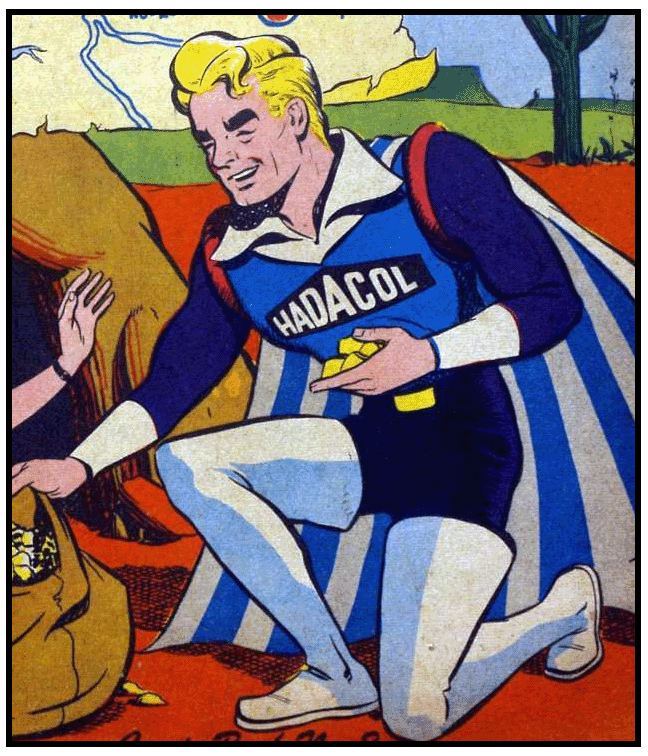
Captain Hadacol: 1951, Captain Hadacol (LeBlanc Corporation). When John Wright takes a sip of Hadacol multi-vitamin tonic, he is transformed into the superhero Captain Hadacol. He is tough, can fly, and even spin fast enough to drill through the earth. NOTE: This is a promotion character much as Volto, Captain Tootsie, etc. The product advertised was supposedly a multi-vitamin that would help perk kids up, improve appetite, etc. It was also 12% alcohol, making it popular in dry states and counties. |
| |
Captain
Halyard: 1941, Captain Aero #1 (Holyoke). "Detective of the
sea Captain Halyard is selected by the F.B.I. to block hijacking
of munition cargoes being shipped to China." |
|
|
Captain
Jack Commando: 1943, Red Dragon Comics #5 (Street & Smith) This
commando soldier/spy wears a colorful outfit sans mask to fight
the foes of America. |
| |
Captain Jim: 1937, Funny Picture Stories v1n5 (Comics Magazine Company). Captain Jim is captain and owner of the steamer Patsy and has adventures across the globe. In China, he fights off some bandits while in Central America he helps fight some rebels. |
|
|
Captain
Kidd: 1939, Fantastic Comics #1 (Fox). Aviator hero and adventurer. His second adventure has him sailing a ship with his lifelong friend Freddy so he's not limited to just piloting. |
|
|
Captain
Magnet:1947, Super Duper Comics (F. E. Howard Publ - Canada).
OSS agent Johnny Calhoun, an OSS agent swallows a scientist's secret
formula which gives him the standard magnetic abilities: flight,
attract and repel metallic objects such as bullets and generic superstrength
and invulnerability. |
| |
Captain Milksop: 1945,
Red Band Comics #1 (Enwil). Mortimer X. Mortimer is a clumsy clerk, constantly breaking things. When he runs into some trouble with crooks, he wishes he had real powers. From an overturned Red Band comicbook come miniature versions of the heroes Bogeyman, Sgt. Strong, the Sorcerer and his Apprentice and even Satanas. They reveal that they have been granted by the copyright holders the ability to grant him a power each (luck from the Apprentice, detection by Bogey Man, magic by the Sorcerer and almost evil by Satanas until the Apprentice kicks him back into the comic). By saying "Red Band Comics" he's struck Shazam-like by lightning and transformed into a costumed hero. This gives him power to wipe up the crooks and collect reward money, but his clumsiness still leaves him in debt to his employer. |
| |
Captain Power:
1944, Jeep Comics #1 (R.B. Leffingwell). Captain Power is a Ranger
fighting the Axis in England |
|
|
Captain Red Blazer:
1943, All-New Comics #5 (Harvey). Captain Red Blazer (also called the Red Blazer at times) and his sidekick Sparky had flame
based powers. He and Sparky got their powers from Dr. Martin. While a prominent cover star especially done by Schomburg,
on the interiors, he and Sparky only appeared in "behind the
cover" text stories. |
|
|
Captain
Red Cross: 1943, War Victory Adventures (Harvey).Hank Greer
is a private in the Medical Corps attached as a medical orderly
to Army Surgeon Major Conrad, but he aspires to the life of a surgeon,
to be more like the Major himself. He dreamed of greatness "...and
here was, a lowly 'medic'... a soldier without a gun, sneered at
by swaggering front-line troops, sneered at until they fell screaming
from wounds...." A surprise attack by the Nazis leads to the capture
of the general present and Maj. Conrad is seriously wounded. Incapacitated,
he gives his ring with a huge gold cadeceus to the private, telling
him to rub it and be worthy. Greer does so and a vision of a gentle-faced
elderly woman dress in old fashioned nurse's garb and a cadeceus
wand appears claiming to be the Spirit of Mercy, summoned by the
Ring. She touches his forehead and with a flash of lightning, Hank
Greer grows bigger and stronger, becoming Captain Red Cross, capable
of great deeds as long as he remains worthy. As the Captain, he
can fly at great speeds, and crash through brick walls. And by rubbing
the Ring, he can change back under the peal of thunder. |
| |
Captain Stand-in:
1946 - 47, Movie Comics #1-3 (Fiction House). Buck Hoskins is
Captain Stand-in aka Captain Standin aka Captain Stand-in Stuntman.
Buck Hoskins is a stunt man in Hollywood, when the Japanese bomb Pearl Harbor he enlists and becomes a pilot and squadron leader, earning the rank of Major. He is shot down, captured and tortured. His face wasn't much to look at before but it's so disfigured that after he's rescued, he gets plastic surgery. His best friend Corey dies during the War. Afterwards, he returns to Hollywood and his actress girlfriend Linda Lawrence. With his new looks, he even manages to step up to being more than just a stand-in stuntman and on the verge of becoming a leading man actor. He's in issues 1-3. |
|
Captain Storms:
1941, Captain Fearless #1 (Holyoke). Whether this is the same as
Cap Stone from Captain Aero, I don't know. In issue 1, he's Captain Hannibal Storms, ace investigator of "Naval Marine Intelligence" in South Carolina! He is sidekicked by Jitter McReady, reporter of The Charleston News. NOTE: In the second issue, his name is apparently changed to Captain/Cap Stone where he becomes a superhero in an underwater kingdom. See "Cap Stone" above. |
|
|
Captain
Tootsie: 1943, Comicbook advertising. Captain Tootsie is an
advertising hero, created to help sell the virtues of Tootsie Rolls.
Whenever danger threatened, he'd pull one of those delicious little
candies from his man-purse which would give him the strength to
meet any threat. Done by C.C. Beck in the same style that made Captain
Marvel famous. To the point that Captain Tootsie graduated from
ads to his own title for two issues in 1950. The comicbook adventures took place in some near future where space travel and mining seemed fairly commonplace. Tootsie is helped by a gang of kids calling themselves the Secret Legion. Whenever there is danger they can call him by a whistle or use secret hand-signs to silently communicate. The main kid that hangs around him is a dark-haired boy named Rollo. There's also Fatso, a rich kid by the name of Caldwallader van Tilden and a girl by the name of Sweetie, whose father is a pilot of a freight rocketship. |
| |
Captain Tornado: 1939, Popular Comics #46 (Dell). Captain Tornado looks like a ship captain, but he's actually the pilot of a rocketship to Jupiter with Professor Bordani, the inventor of the rocket, and his daughter Jane. |
|
|
Captain
Truth: 1945, Gold Medal Comics #1 (Cambridge House). Ken Elliott
is the superpowered Captain Truth. He's bulletproof, can fly and
might possess above average strength and senses. While he lives
on his own, Ken appears to be only a teen-ager. |
|
|
Captain
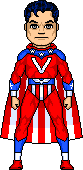
V: 1944, All Top #1 (Fox) 1944, All Top Comics nn (Fox). When evil threatens, puppet shop owner Alan Dale plays the "V…-" notes on his organ which transforms him into the patriotic Captain V. He has some low level super-strength and can travel swiftly through the air on the red, white and blue V-beams. After his one appearance, he is re-done as the Puppeteer. |
|
|
Captain
Valiant: 1944, Variety Comics #1 (Croydan). Actor Bruce Barton
decides to act like a crimefighter, so he puts on a costume to fight
crime. |
|
|
Captain Victory:
1941, Our Flag Comics #1 (Ace). Jack Wilson is a young American diplomat attache. He is also secretly Captain Victory. Captain Victory has Superman like powers. He can leap great distances, fly, and is strong enough to rip through steel. He is able to be chloroformed though. His shirt appears to be made of chain mail or scale mail. There's no explanation as to the origin of his fantastic powers. |
| |
Captain Wings:
1941-42, Wings Comics #16 (Fiction House). Captain Smith aka special
agent and RAF veteran Captain Wings is the epitome of the non-costumed
pilot heroes. Even when the War is over, he continues the good fight
against Communists, spies, and UFOs. |
|
|
Captain Wizard:
1946, Red Band Comics #3 (Enwil). A war veteran, unjustly accused
of murder, hides from the Law in a wax museum. He's discovered by
a magician with the unwieldy name of Theophrastus Bombastus Paracelsus.
The magician recognizes the vet's innocence and gives him a magical
cloak and tells him to "be off, do good." The cloak gives Captain
Wizard the powers of flight and invulnerability. He's helped by
Baldy Bean. |
|
Captain Yank:
1942, Big Shot Comics #29 (Columbia). Heroic soldier fighting the
Japanese in China. Helped by the Asian woman Wing. |
| |
Kenny Carr: 1940, Planet
Comics #3 (Fiction House). Kenny is a British Captain in the "Martian
Lancers." The Martian Lancers are identical to the British Lancers
of India, down to the Martians wearing turbans. |
| |
Cutter Carson: 1937, Funny Picture Stories v2n2 (Ultem/Centaur). Cutter Carson is a U.S. naval officer |
| |
Flip Carson: 1948, Tim Holt #3 (Magazine Enterprises). Flip is a Federal Marshal in the Old West. He carries two Colt six-shooters on his waist, a rifle in his saddle. Appeared in text stories. |
|
Rip Carson: 1942, Fight Comics #19 (Fiction). Another aviation hero, he lasts longer than most, surviving WWII and goes on to fight the Communist Menace in Korea. His would-be girlfriend is the base nurse Peg while his would-be rival is his Sarge. While he's depicted on the early covers with dark hair, he's blond in the stories. In the end of issue 45 (1946), he forms Risks, Unlimited with pals and side-kicks for part of his run Texas, Brooklyn and Chet when they are mustered out of the paratroopers. Right off the bat, Chet Smith gets married and is thus gone. |
|
|
Craig
Carter: 1940, Wham Comics #1 (Centaur). Archaeologist Craig
Carter once saved the life of Egyptian Say-Aben Touman who sends him
a magic ring just at the time that Craig has announced his desire to quit archaeology and become a crime-fighter (no mention of how he plans to make a living at it, maybe he made a fortune digging up treasure). When he rubs the ring it calls forth Zeus who tells him he can use it to call upon and command the gods. While he only calls forth Zeus and Mercury, it implies that he can actually call ANY god such as Thor. He likes to have a pegasus fetched for him to use as a steed. Another drawback is that even though he's wearing it, anyone rubbing it can accidentally call forth the gods though he's the one still in control. |
| |
Crash Carter: 1941, Exciting Comics #16 (Standard). Young Tom Carter is bugs about flying and enlists as a cadet for pilot training for Uncle Sam. However, he crashes a trainer and thus earns the nickname of "Crash". His pals are Horace "Stew" Kent and Looie Tizzle. Of course, they spend quite a bit of time foiling various plots of Nazi agents. |
| |
Sgt. Dick Carter:
1941, Captain Fearless #1 (Holyoke). In these uncertain days of War, Carter is a trooper of the Border Patrol. |
|
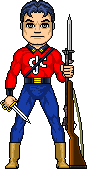
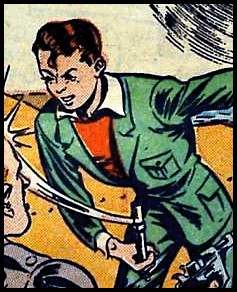
Kit Carter: 1941, Target v2 #4 (Novelty). Kit Carter is a cadet at Daunton Military Academy. While the strip is called "Cadet" it's not his code name. |
| |
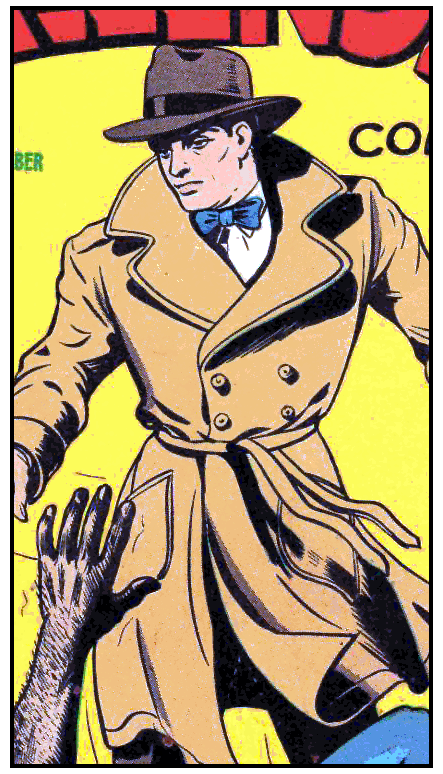
Nick Carter: 1886, The Old Detective's Pupil; or, The Mysterious Crime of Madison Square (Street & Smith); 1940, Shadow Comics #1 (Street & Smith). Nick is raised to be a scientific detective. He uses various gadgets such as spring-loaded guns, bulletproof vest. He's assisted by his adopted son Chick. In some stories he's described as being short, but he's still two-fisted and strong. NOTE: It should be noted that Nick debuted BEFORE Sherlock Holmes. He first appeared in Dime Novels, then later revamped for the pulps, radio, comics and movies! In the 1970s, he got revamped again in the violent men's paperback spy-detective novels as The Killmaster, sharing the racks with the Executioner, the Destroyer, the Hawk, etc. The Doc Savage pulp series was designed to be along the lines of Nick Carter. |
| |
'Smoke' Carter: 1939, Speed Comics #1 (Harvey).Heroic fireman. |
| |
Matty Case: 1946, Blue Beetle #44 (Fox). Matty is a private detective and capable of doing a bit of undercover work in solving his cases. |
| |
Steve Case:
1943, All New Comics #1 (Harvey). "Steve Case, Crime Rover," is
a hard-nosed crime reporter. |
| |
Pepper Casey: 1942, Boy Comics #3 (Lev Gleason). Pepper is a young lad but also a boxing prodigy, even full-sized boxers feared the speed of his fists. He has a big sister Molly who dates the boxer Natty O'Daniel. After Pepper wades into some toughs that were harassing Natty after an under-handed defeat, Natty volunteers to train the young lad and then convinces his manager Macobs to arrange a match. Which the kid easily wins and promises to set him on the path towards adventure |
|
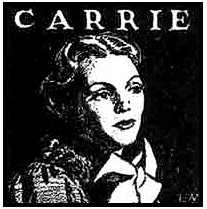
Carrie Cashin: Pulp: 1937, Crime Busters. Comic: 1940, Shadow Comics #1 (Street & Smith). Carrie is head of the Cash and Carry Detective Agency. As clients are reticent on hiring a woman p.i., the front man is Aleck Burton who provides some muscle. Carrie is smart, pretty and tough and won't let the Law or a little breaking and entering get in the way of solving a case. NOTE: Created for the pulps by Theodore Tinsley. |
| |
Tim Cassidy: see "Captain Sheridan" under "S". |
| |
Cat-man: 1939,
Amazing Man Comics #5, (Centaur). Barton Stone had somehow fallen with some bad guys (Steve "Chuck" Harrigan, now a political boss; Roger Watson "Slick" Hammond, stockbroker; and Lionel "Blackie" Black, real estate agent) and for some reason took the rap for them in some crime and spent 20 years in prison, where they expected him to die. While there, his wife died in misery and poverty. Upon release, he confronts them, turning their offers of money down, and instead vows that each will die one by one without him getting the blame for it. He dressed up as an old woman and arranged individual meetings where his/her cat would scratch his chosen victim. He then would send a note forecasting the hour of their death. The deaths all had the appearances of being heart-attacks and no one made the connection between them and the kindly old woman, just that somehow Barton was getting his revenge. After he got his vengeance, he had at least another outing, doing away with another gangster the same way. While in prison Stone seems to have mastered chemistry, especially explosives and poisons. He also wears a bullet-proof vest even when disguised as an old woman. |
|
 

|
Cat-man II: 1940,
Crash Comics 4 & 5, Cat-Man Comics 1-32. 1940. David Merryweather
was one of the many heroes who got his start when his parents were
killed while in the jungle leaving the orphan to be raised by animals,
but one of the few to actually adopt a costumed identity. His adventurous parents were killed by bandits while in Burma and he was raised by a tigress. Early
in his career, he had all the attributes of the cat: agility, night
vision and nine lives granted by a cat goddess. Eventually, he joins the army and gains an eleven year old
ward, Katie Conn, who dresses in an identical outfit and calls herself
Kitten (1941, Cat-Man Comics #5). Katie's acrobat parents were killed when their circus train wrecked and was already a trained acrobat. She was then being raised by her Uncle Jake, a drifter and thief until he tried to hold up Merryweather and she decided to intervene. She further proves herself on the case he was working on and thus, instant partner. She also worked
with other side-kicks as part of the group Little Leaders. By war's
end, Kitten is depicted as pretty much a late teen to full-grown woman.
Issue 27 gives a second version of the origins of Cat-Man and Kitten. In this one, Cat-Man's mom is is the best animal trainer in the country. As such, as a kid, he's completely at home with the big cats who accept him as their own. When his mom is killed under mysterious circumstances, he grows up to follow in his mother's footsteps. He also learns the ways of the cats, able to move as stealthily as them. One day he finds an orphaned baby in the pen with Tamara, his favorite cat who seems to accept the baby as well as she accepts David. The only name on the tag is "Rosetta" so he names her Katie "Kitten Rose" Rosetta in honor. The steps from there to them actually becoming the crime-fighting duo Cat-Man and Kitten are unclear though. The story does mean that David Merryweather had raised Kitten from baby to young teen, thus may be a bit older than your average mystery man of this time. If you buy the second origin that is. |
|
|
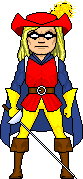
Cavalier: 1946,
Thrilling #53 (Better). When the Duc De Chantrey's portrait frowns,
curio shop owner Rance Raleigh knows trouble is afoot and he dresses
as a French cavalier (in homage to the Duke) to fight crime. He's
helped by Brooklyn friend Rocky. He's not averse to using a gun
in addition to his foil. |
| |
Cave Girl: 1952, Thun'da
(M. E. Enterprises). Orphaned when bloodthirsty natives kill her
parents, young Carol is spirited away by a large eagle over the
high mountains, Barriers of the Moon, to the Dawn Lands,
a hidden valley where roam men and beast "as in the time of
the world's beginning.". The eagle is killed by Kattu the wolf
who takes Carol into the pack and raises her. Time passes, Kattu
grows old and dies and new wolves join the pack now lead by Cave
Girl who has mastered bow and spear and language of the beasts. |
|
Challenger: 1946, The Challenger #3 (Interfaith Committee of Protestant Digest). Bill Day is the Challenger and is progressive for his time, fighting fascism and especially racial and religious discrimination and union busters, by going after these who fuel racial tensions, labor unrest, and riots. He is still a two-fisted hero and carries and uses a gun. He doesn't wear a mask and it seems common knowledge that he's the Challenger. |
|
|
Chameleon: 1940,
Target Comics #6 (Funnies, Inc). Pete Stockbridge is the enigmatic
Chameleon. He's a master of disguise |
|
The
Champ: 1939, Champion Comics #2 (Harvey). As a young boy, he was a runt of the neighborhood, frequently picked on and beat up by other boys who gave him the nickname "the Champ" because of it. One day this was witnessed by a visiting Dr. Marlin. Intrigued, the doctor got lodgings at the Champ's Mom's house. He saw the boy was not eating healthily and that was the first change he put in place: plenty of cereals and vegetables. This was followed by regular sleep and exercise which the young boy responded to. It was then the doctor decided to try out his tonic, a special supplement full of vitamins and life-giving elements. He soon showed more energy and endurance. The doc was a boxing and wrestling champ himself in his college days and taught the boy himself. To the point that years later, the Champ is a champion athlete as well as a top student at Midwest University (sometimes Midwest College). Part of what makes him better than others is a special tonic prepared for him by his sponsor and mentor Dr. Marlin. It has a nut-like flavor and it adds zest to his cereal and heightens his already considerable physique to make him a perfect physical specimen. But, now that it has been seven years, so his body has reached the potential, that he no longer has to take the tonic as long as he eats right, exercises, and gets plenty of sleep. He originally wants to make the forumula available to all youth, but Dr. Marlin is killed by his assistant, a hireling of the Yellow Spider before he can reveal the secret formula to the Champ. Champ manages to kill the Yellow Spider, an act he feels remorse over though feels it was also necessary.
The formula goes missing again, having been mailed to a Dr. Koch by Sue Katsu. The Champ, his pal Henry and Sue go to Mexico to retrieve the formula and while Koch soon shows his villainy, the Champ is temporarily unaware of Sue's duplicity (she's related to the assistant who slew his mentor). However, once she's allowed to flee with a fake formula, this plotline seems forgotten and the Champ goes on to have more prosaic adventures.
The Champ is an all-around
champion athlete. In addition to adventures in college sports, he
also goes against criminals and spies. His friend Henry is of slight build and wears glasses. His real name is unknown,
everyone just calls him "Champ". |
| |
Happy Chandler: 1941, War Comics #4 (Dell). Happy Chandler, ace flyer, high spirited adventurer, is the two-fisted, danger-loving son of the president of the American Broadcasting Co. His reckless antics, while they have earned him the title of the modern Don Quixote, are a constant source of annoyance to the elder Nelson J. Chandler..." |
| |
Chessmen: 1947, International Comics #2 (EC). The Chessmen are a group of English and Irish agents who take their code-names from chess pieces and are also part of the International Crime Patrol. There is the Queen who is their leader Lisbeth Lake, the Pawn, the Rook, the Bishop, and the King. |
| |
Citizen Smith:
1941, Captain Fearless #1 (Holyoke). Also billed as "Son of
the Unknown Soldier". John Smith is an orphan and feeling drawn to the tomb of the unknown soldier, also a man with an unknown past, he visits and humbly pays his respects. He's visited by the spirit of the unknown soldier, claiming to be Smith's father. Smith is charged then to become the guardian of liberty and the ghost says he'll come if Smith needs him. Remarkably similar to Captain Fearless of the same comic and Fighting Yank though Citizen Smith does not wear a costume. |
|
City Girl: 1942, Champ Comics #21 (Harvey). Betty Caldwell's younger brother Eric is a talented speaker and speaks out against crime to full auditoriums and naturally his mother and sister are proud. However, gangsters seek to undo his crusade by framing and kidnapping him. Betty and her boyfriend Bill, a heavy-weight champion of the U.S. Marines go after the crooks. While Bill is an asset, Betty shows herself able to throw a punch with the best of them and seems to have some judo skills as well, tossing a full-grown man with ease over her shoulder. |
|
|
The
Cloak: 1940, Big Shot #1 (Columbia). Agent Jeff Cardiff puts
on a cloak over his suit to fight enemy agents here and abroad for
the U.S. Started off as Spy-Master, then Spy-Chief before settling
on the Cloak. In one adventure, it's revealed he also has a dog named Rex. |
|
|
Clock: 1936, Funny Pages #6 (Comics Magazines). One of the oldest comic
heroes and published by enough companies to cast his ownership in
doubt (one of which was Quality). Brian O'Brien was a wealthy young
man falsely accused of killing his own father for the inheritance.
While in prison he met up with "Pug" Pulaski and struck up a friendship
with him. While talking with Pulaski, O'Brien realized that no one
was going to bother to find the evidence to free him from this frame-up
except himself. That resolved in his mind, the two of them escaped
from the prison. As they searched for evidence of their innocence,
they wore kerchief's to conceal their identities. It didn't take
long to find the evidence that they needed to legally release them
both from prison. Having freed himself, O'Brien realized that there
must be many other people out there in need of help. He and Pulaski
kept their kerchiefs and pursued the truth to help the innocent
for many years.
After he switched companies, the Clock eventually got a new sidekick, an orphaned tomboy living on her own by the name of Butch who was determined to help him out and would marry him once she grew up. |
| |
The Clown: 1941,
Spitfire Comics #1 (Harvey). Nick Nolan is the newly appointed police commissioner of Newtown. He serves because of a family tradition, whether specifically as commissioner or in law enforcement in general the text does not say. However, crime is rampant and any in-roads is stymied by the lawyers. Which is enough to make Nolan wish he was back in the circus. This inspires him to hit the streets dressed as a clown advertising the coming of a circus. The disguise allows him to infiltrate and smash the protection racket of Harry Judd and his crooked lawyer Moore. Nolan calls himself an “acrobatic clown” and shows that he is a good fighter, can scale a building, and juggle balls which he has filled with gas (his mask also works as a gas mask). In his second appearance, he walks around with a sign advertising “Circus Brand Cereal”. |
| |
Anthony Cobat: 1945, Red Circle #3 (Enwil). Dark haired Major Cobat is with Military Intelligence. Because of his knowledge of international affairs he goes on secret undercover missions. |
| |
Bob Colby: 1937, Funny Picture Stories #6? (Centaur). Bob is an adventurous young wanderer. He is clever and a decent detective but has no apparent career or means of support. |
| |
Dick Cole, the Wonder Boy: 1940, Blue Bolt #1 (Funnies, Inc). Dick Cole is left
as an infant on the doorsteps of Professor Blair
of the Farr Military Academy. The Professor takes a page from Doc Savage's father and raises him to be a virtual physical and intellectual superman. As a teenager, he's strong, incredibly athletic and capable. He and his friends have all sorts of adventures at the Academy. No one actually addresses him as Wonder Boy. |
|
Jimmy Cole: 1942, Thrilling Comics v11n2 (32) (Standard). Boy detective. His father assigns the adult Tom and an African American servant called Horatio to curtail the lad's amateur detecting which never works. He uses a recorder called the Electro Soundtrap to aid in his adventures. Horatio talks in stereotypical dialect but at least is drawn somewhat realistically and is courageous and capable in a fight; he's willing to hold off a shark armed with only a knife. |
| |
Nelson Cole:
1940, Planet Comics #1 (Fiction House). Captain Nelson Cole is a
top member of the "Solar Force," a space police organization. He
also, on at least once adopted a superheroic identity known as Torro,
equipped with special clothing and a whip. He also once visited
Earth and stopped World War Two. His sidekick is Bud. |
| |
The Collector: 1945, Mask Comics #2 (Rural/Enwil). Hanson Riordan is policeman chafing at being a beat cop and directing traffic as opposed to fighting crime. He saves an old man from being rundown by some bank robbers and sets out to catch them. However, he is shot and killed for his troubles. At the pearly gates, he witnesses General Yamamoto being sent to Hell and discovers that he is not on the list to have died that day. St. Peter (presumably) calls forth the Collector from the Sands of Time Department to account for this and to Riordan’s surprise, the Collector is the old man he had saved. The gangster Gus Gorilla was to have died when the car swerved to avoid the old man, a fate averted when Riordan had “saved” him. Deciding that fresh blood is needed in the Sands of Time Dept., Riordan is made its newest Collector and sent to collect Gus Gorilla. His spirit re-animates his body and he quickly chases down Gus. In a panic at seeing the “dead” cop running pace with the car, Gus panics and causes the car to go out of control, crash and kill him. Riordan is told that his body will now have much greater powers, but the only powers we see once he merges back with his body is running at super speed. |
| |
Chip Collins:
1940, Fight Comics (Fiction). Captain Chip Collins, sky fighter,
is in command of the Skull Squadron, a secret group of fliers that
undertake missions on behalf of the government, stationed on mighty
air-craft carrier S.S. Dolphin. His wing man is Jinx Jordan, a freckled
red-headed veteren flier. An interesting note, is how the airplanes
advance as the strip progresses, starting off with some simple bi-planes
and quickly advancing to cutting edge planes. As the strip progresses,
the Skull Squadron angle is dropped. Chip eventually becomes a flier
for the RAF and then America. |
| |
"Duke" Collins: 1940, Super Spy #1 (Centaur). Duke is a US Marine, in love with Sue Webb, and runs afoul of foreign agents out to destroy the Panama Canal. He's an accomplished pilot as well as a fighting man. |
| |
Captain Colt: 1941, Speed Comics #12 (Harvey). Officer of Military Intelligence. In issue #13, he was apparently promoted to Major |
|
|
Commandette:
1945, Star Studded Comics #1 (Superior Publications). Betty Babble,
ex-stuntwoman and currently filming a movie called "Commandette."
So, she happens to be in costume (white dress, blue mask, green
hat and cape) when trouble strikes on the set. |
| |
Commando Cubs:
1943, Thrilling Comics #36 (Better). Ace Browning, Pokey Jones,
Horace Cosgrove II, Whizzer Malarkey, and Spud O'Shea are the Commando
Cubs, a Boy Commando-esque group of kids who do their part for the
war effort fighting the Enemy. |
|
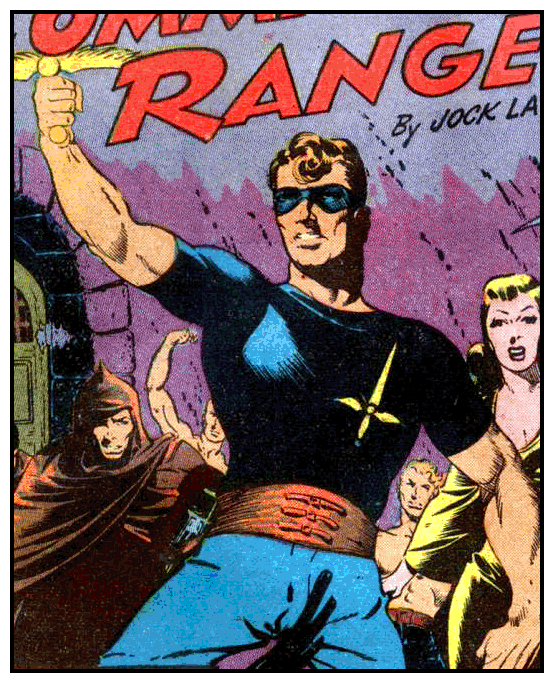
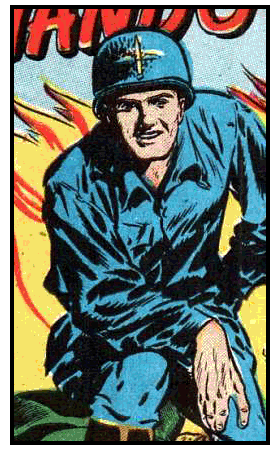
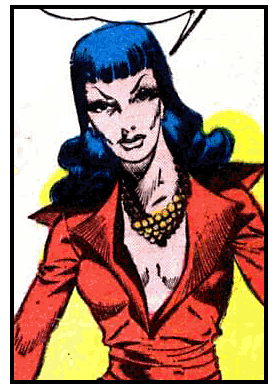
Commando Ranger: 1943, Ranger Comics #13 (Fiction). The Commando Ranger is an Olympic champion able to k.o. a hewavy weight contender, a scientist-explorer who fought a plague in the Congo, a mysterious ace pilot, a sole survivor of a ship sunk by pirates in China seas and climber of Mount Everest. In Tibet, he spent two years mastering mind over matter where he hears the plea of those enslaved and is sent by the lamas back into the world. Which leads him to put on a mask and costume to help conquered countries fight the Nazis regime. His girlfriend is a leader of the underground known as La Bastille. He is willing to kill and leaves behind notes with a diagram of a winged dagger to identify his work. He doesn't show any overt powers while fighting the Nazis but he is coldly efficient, and handy with his winged knife. In the following issue, he wears more conventional dark clothing, with emblems of the dagger over his heart and army helmet and he's off to meet and help more beautiful women to fight the Nazis and their allies.
|
| |
Commandos of the Devil Dogs: 1941, Catman #2? (Holyoke). Corporal Wally White and Sgt. Bill Tanner are two extremely capable Marines undertaking various secret missions. Once the War starts they get sent to the South Pacific with the rest of their squad under the command of Captain Grey.. There, they often go AWOL pursuing personal missions against the Japanese and rescuing the chief's beautiful daughter Shalna they have a crush on. |
| |
Congo Jack: 1941, Lightning Comics v2#1 (Ace)?. This dark haired great white hunter ends up getting kidnapped by the Mole Men for their games. Instead, he wins the attraction of their beautiful albeit green-skinned queen Moletta and the enmity of the jealous and ambitious Lugi. Once Lugi's threat is ended though, Jack returns to the surface world. |
| |
Congo King: 1946, Atomic Comics #4? (Green). Dark-haired Tarzan type, no name given other than Congo King. He's got a family in the jungle with his brunette mate Tonda and blonde boy Kuta. Note: Atomic Comics contained reprints from various comics and in some cases changing the text and art to imply new characters and stories. In this case, Congo King is really a bastardized Jo-Jo, the Congo King with his mate re-named and the boy Kuta recolored from a native to a caucasian. The story in Atomic Comics #4 is from All Top Comics #8 (Fox) minus some pages. |
|
|
Congo
Raider: 1945, Lucky 7 Comics #1 (Howard). Costumed Superhero
of the jungle, protecting civilized men who are easy prey of the
dark forces of the jungle. Looks to be a re-working and coloring
of a version of the Red Panther. |
|
|
Conqueror:
August 1941, Victory Comics (Hillman). Daniel Lyons was obsessed with a personal mission and was flying cross country in a storm when he crashes. He's thrown clear but injured and near unconscious and he stumbles along to a house where he collapses. The house belongs to scientist and physician James Norton, also known as "the cosmic ray professor". Lyons is unconscious for 5 days, during which Norton treats him with a cosmic ray lamp. By the time Lyon regains consciousness, he is twice as strong, heals twice as fast, twice as smart. He reveals his obsession, to rid the world of Hitler. Norton sympathizes and aids him by giving him more treatments and then a letter of recommendation to the President. Thus, he ends up in Europe with letters of identity to the various ambassadors and heads of state of Allied countries, giving him basically freedom of movement. However, the War is kicking into high gear and Lyons realizes it's going to take more than one man, but a symbol for people to rally around. Thus, the Conqueror is done. His origin was revealed in the text stories, in the comics, he doesn't seem any more super than your average Captain America. By Bill Everett. |
| |
Copper Slugg:
1940, Wham Comics #1 (Centaur). Copper Slugg is a two fisted cop. He doesn't carry a gun, preferring to use his fists. However, he does have a bad temper and is prone to acting and thus hitting without thanking things through which puts him on the edge of being fired though the Chief likes him. |
| |
Trooper Pat Corrigan:
1941, Captain Fearless #1 (Holyoke). Corrigan is a two-fisted, gun-wielding
state trooper for New York who diligently patrols the highways and
by-ways of rural New York state. |
| |
Cosmic Carson:
1940, Science Comics #1 (Fox). Cosmic Carson is the "ace rocket
pilot of the Interplanetary Patrol." |
| |
Bill Cosmo: 1946, Future World Comics #1 (George W. Dougherty Publishing). Bill is a young atomic scientist, looking to get in on the ground floor researching atomic energy. He was the prize pupil of Professor Gay and jumps at the chance to work with him. However, Gay's old assistant has gone off the deep end, whose paranoia, miscalculations and acts of sabotage not only endanger his job but everyone's lives. Has a younger brother Johnny. |
|
|
Cosmo Mann:
1941, Bang Up #1 (Progressive). Cosmo Mann discovers the "G Ray"
which he uses to invent the Sun Ray Gun and a suit that allows him
to fly.. Cosmo fights the good fight, aided by his lab boy Archy.
His Sun Ray Gun is a disintegrater and able to paralyze foes as well as emit a field to melt bullets. His
main enemy was German Commander Darke. |
| |
Lucky
Coyne: 1937. Funny Picture Stories v2#1 (Centaur). Lucky started out as a police detective with a mustache and no coin flipping that he'd later be known for. Eventually, he was
a private detective, albeit an eccentric one. He carries a coin
and flips it to make decisions. Heads, he takes action; tails, he
does not. He is helped by Terry. Otherwise Lucky is very good at
his job. In later books by Chesler, he's a reporter, still helped by Terry and the pretty Kitty and still uses coins to make decisions. NOTE: Lucky Coyne was most likely supplied to Centaur from the Chesler Studio. As such, he would switch titles and companies, before ending up at MLJ. Details concerning the character were obviously inconsistant. |
| |
Frances Craig: 1945, Eagle Comics #2 (Rural). Frances abandoned a career in order to be a pilot in the Civilian Air Patrol. In her first (unpublished?) air adventure, she met up with Captain Don Winston of an interceptor squadron on the Atlantic coast. Since then, they had seen a lot of each other and he added to her knowledge of planes and flying. Together, they round up a bunch of thieves, Frances proving to be a bit of a hell-cat fighter when the situation calls for it. |
| |
Sgt. Jim Craig: 1937, The Comics (Dell). Sgt. Jim Craig is a heroic state trooper (which is the name of the strip), his boss is Captain Norton. They are after “Boss” Leeds, who kidnaps the governor elect. |
|
|
Buzz Crandall:
1940, Planet Comics #1 (Fiction House). Buzz is a lieutenant in
the Space Patrol. With advice by Dr. Curan and helped by Sandra,
Curan's daughter, he rockets through space exploring worlds. |
| |
Crane of Scotland Yard: 1939, Keen Detective Funnies v2n4 (Centaur). Ran for several issues |
| |
Detective Crane:
1940, Superworld Comics (Komos). Crane is a police detective. |
|
|
Ted Crane: 1940,
Exciting Comics #2 (Better). Ted Crane is a world travelling explorer
and adventurer along with his girl Betty Hawkins. While he started
off in Africa, he spent quite a bit of time in Asia fighting against
Dr. Cobra and the Japanese. But he kept the pith helmet. |
| |
Crash, Cork and the Baron: 1939 Speed Comics #1 (Harvey). Ace eagle pilots in India. Crash is blonde, Cork red-headed, and the Baron sports a pencil thin mustache and monocle. Eventually, they travel back to the States to continue with their adventures. |
| |
Crash Kid: 1945, Cannonball
Comics #1 (Rural Home). Rusty Adams works by day as a copy boy for
the Daily Herald. When danger looms, Daily Herald copyboy Rusty
Adams puts on a costume and becomes Crash Kid, Good in a fight but
no powers. |
| |
Steve Crawford: 1941, Liberty Scouts #2 Centaur). Ace Federal man, his specialty is going undercover to the point he's called "the undercover man". In his published case, he stops the plans of Dr. Dietz and his disentigration ray gun. |
|
Crime Crusader: 1945, Cannonball
Comics #1 (Rural Home).Jonathan Jones is a private investigator also known as the Crime Crusader. The term "Crime Crusader" does not seem to be a secret identity, and seems to alternate between serving as a name and as a description of his vocation. He's a decent fighter and detective. Helped out by the dimunitive Wash Tubbs type Kewpie O'Toole who has a penchant for dime novels. |
| |
Crimebuster:
1942, Boy Comics #3 (Lev Gleason). When Iron Jaw and the Nazis kill
his parents (among a boatload of others), military school cadet
Chuck Chandler takes matters in his hand. His chief foe is Iron
Jaw, but he tacles all sorts of enemies and social ills. His costume
is a little more home-made than most, just his hockey uniform and
cape (he eventually discovers girls and starts wearing regular clothes
than that outfit all the time). His partner is his monkey Squeeks |
| |
Crimson Avenger: 1954, Masked Ranger ? (Premier Magazines). Not the Crimson Avenger you're thinking of. He's "protector of the weak, defender of the right, the Crimson Avenger, born a white boy as Victor Kincaid, but raised among his friends, the indians as Lone Eagle ranged from the burning deserts of Apache country to the stormcrowned mountains of the Blackfeet!" When he's dressed as a white man, he goes by the name of Kincaid, but when he goes as a bare-chested indian, he's Lone Eagle but known as Crimson Avenger in either identity. His intelligent all black horse is named Black Demon. |
|
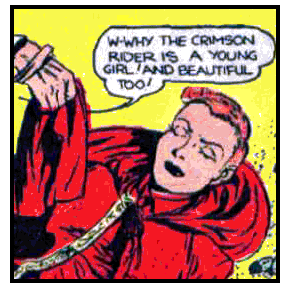
Crimson Rider: 1939, Jumbo Comics #9 (Fiction). The Crimson Rider is a masked rider all decked out in red. The Rider is really a beautiful woman, named Mary Bennon, her father killed by the villainous Payson gang. Even after being brought to justice, she continues as the Crimson Rider, helping out Wilton of the West and Snorty.
|
| |
Criss
Cross: 1944, Jeep Comics #1 (R.B. Leffingwell). Criss Cross
is a master locksmith. |
|
|
Crusader: 1941,
Victory Comics #1 (Hillman). No name or origin, the Crusader wages a personal war against German agents and 5th Columnists. When in his first case he solves the case of a ghost at Graydon Castle, he buys the castle from the owner. He fights other colorful villains such as a vampire and Groff, the man with green eyes. |
| |
The Crusaders: Bob Crawford,
Paul and his sister Lois Leighton (and Bob's fiance) are adventurers
on a faraway planet in the kingdom of Kranto and have become trusted
aides to the king. Their foes are the rebel Prince Dahn and the
Mad Magician Mordu. The prince ultimately reforms and aides them. |
| |
The Crusoes: Crackajack Funnies.
A Swiss Family Robinson strip. |
| |
Space Admiral Curry:
1940, Planet Comics #5 (Fiction House). Space Admiral Curry is a
leader of spaceships and men and uses the forces to fight the evil
Rocko. |
|
|
Cloud Curtis:
1940,Silver Streak Comics #6 (Lev Gleason). Adventurer Cloud Curtis
flies his incredibly fast plane, the Golden Bullet. He's helped by his two closest friends, "Pop" Whistler (elder inventor) and "Crusher" McCoy (a big bald strongman type). |
| |
Storm Curtis:
1940, Prize Comics #1 (Prize). Storm Curtis is a Coast Guard captain. |
| |
Captain Cutlass: 1946, Black Cat #2 (Harvey). The original Captain Cutlass was a pirate dead for around 200 years who left a buried treasure somewhere in Florida and gave half the map to a man called Bloodgood who had a mansion on the edge of Black Water Swamp.. Twenty years ago in Florida, Jose Bianco killed John Bloodgood's father and thought he'd killed his son for their half of Captain Cutlass' treasure map. Grown up, Bloodgood disguises himself as Captain Cutlass to avenge himself on Bianco and his large African servant Congo and the Swamp claims both as victims. He splits the treasure with Whipper Burns and Stretch Malone, two good natured boys who had found the other half of the map. |
|
|
Cyclone: 1940,
Whirlwind #1 (Nita Publications). Peter Blake trained for years
"in jiu-jitsu, athletics, and acrobatics in order to fight crime
with the fury of a hurricane and force of a tornado." He shows some indication of powers as he is able to conduct great leaps and the art implies a boost of whirlwind makes this possible but he doesn't actually fly or use wind powers in any other way in the two stories I've seen. He is otherwise simply
a physical marvel along the lines of Doc Savage. A pity the strip
didn't live up to that pedigree. |
| |
Cyclone & Midge:
Crackajack Funnies. An unusual western strip. Cyclone is the muscular
barrel chested hero who goes about shirtless and hatless but wears
furry riding chaps and a six-shooter on each hip. Midge is his "pardner,"
a slender midget in tails and top hat with a few magic
tricks up his sleeve. Nor do they constrain their activities to
the American West but travel to wildlands of Australia. |
|
|