| |
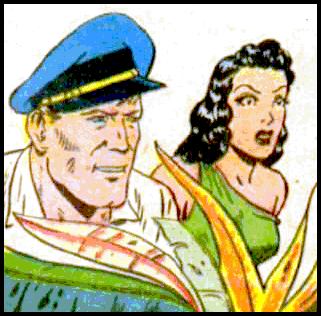
Cap'n Dig Bailey: 1946, Calling All Boys (Parents' Magazine). Dig Bailey is the captain of the tugboat Broadside. His crew consists of Zeke with a billy-goat beard and the chunky Archie. When not on the waters they stay at Abigail “Ma” Martin's boarding house. |
|
Rocky Baird: 1937, Funny Picture Stories v1n4 (Comics Magazine Company/Centaur).. James J. “Rocky” Baird is ex-prize fighter and got tired of living a regular life so he set out for adventure, in this case in the East. He proves to be as good a pilot as a fighter. |
| |
Biff Baker: 1942, Major Hoople Comics #1 (Standard). Biff Baker is in college studying aeronautical engineering. In his single appearance he stops the theft of the plans to an advanced plane. For another Biff Baker |
| |
Flint Baker:
1940, Planet Comics #1 (Fiction House). When his scientist father
died, Flint was left with the duty to completing his spaceship to
be sent to Mars. He does so and explores space with his girlfriend
and reporter Mimi Wilson and some ex-cons with hearts of gold: Harry
Parks, Cliff Grant, and Phil Godwin. In issue #26, he teams up with the explorer Reef Ryan and become part of the crack team of Space Rangers commanded by Borla, the Martian. |
|
|
Bald Eagle:
1941, Air Fighters Comics #2 (Hillman). Jack Gatling lost his hair
flying through a fire. He fights the Japanese, in his plane, the
Fying Coffin. |
| |
Dusty Ballew: 1948, Prize Comics Western #69. Dusty and side-kick Gumption Jones are cowboy heroes in the late 1800's Tombstone. |
| |
"Buzz" Balmer:
1941, Bang-Up #1 (Progressive). Teenage Buzz is accidentally shrunk
down to doll size by his father, Professor Balmer. His father shrinks
a plane for him and he has Doll Man-esque adventures. |
| |
Inspector Bancroft:
1939, Mystery Men #1 (Fox Features). Inspector Bancroft is a Scotland
Yard detective reporting to Chief Inspector Grainger.. |
| |
Biff Bannon:
1939, Speed Comics #1. Biff is an adventurous U.S. Marine. |
|
|
Banshee: 1941
Fantastic Comics #21 (Fox) When Jim O'Donnell's stepfather is killed
in Ireland by the masked villain the Scorpion, he follows the villain
to the U.S. and defeats him by pure luck. Despite this less than
auspicious beginning, he decides to continue fighting crime. He announces his presence by letting out a moaning cry to spook his opponents. His girlfriend is Joan O'Neill. |
| |
Bantam Buckaroo: See "Little Lobo". |
| |
Crash Barker: 1940, Planet Comics #6 (Fiction House). Crash Barker is the “foremost American stunt flyer and racing driver,” drawing crowds with his shows. However, when they debuts his new invention, the “Zoom Sled”, they ridicule him. He proves his word when he takes off in the ship, a thousand mph in low speed. He earns the enmity of enemy agents who want the plans as well as Bart Clay, the spoiled son of the airport owner of the Mid-Western airfield where he tested his ship. The small town is also named “Clay”. Bart feels Barker made a fool of him, first with the noise and laughter beforehand and then showing him up in front of the crowd and authorities when he tried to get him thrown off the field. Barker is assisted by the brutish “Wheel” Barrow, his co-pilot and his girlfriend Betty. |
| |
Bruce Barlow: 1940, Whirlwind Comics #1 (Nita).Bruce Barlow is a young scientist and adventurer. He attends a meeting of leading scientists investigating bolts of electricity that are coming from the inside of the Earth and causing destruction. The proper course decided, he rides inside of a projectile shot into the crater of the world's greatest volcano. He discovers an underground kingdom ruled by Muskog who seeks to conquer the surface. He is helped in overthrowing Muskog by the beautiful princess Eda. The next issue has him rocketing into outer space to uncover comets smashing into Earth. The first issue establishes this takes place in the futuristic year of 1980! |
| |
Barnstormer Barnes: 1945, Eagle Comics #2 (Rural). As his name would suggest, Barnstormer Barnes and his attractive companion, co-worker and co-pilot Jenny are barnstormers in the Midwest. |
| |
Bill Barnes: (Comic) 1940, Shadow Comics #1 (Street & Smith). Bill Barnes is an aviation hero, starting in the pulps in 1934 before appearing in the comics. He flew advanced aircraft and had his group of assistants like many of the other pulp heroes like Doc Savage whom he heavily imitated at the start. They were the teen-aged pilot Sandy Sanders, short WWI ace Shorty Hassfurther, Bev Bates, and mechanics Scotty MacCloskey and Tony Lampert. |
| |
Buzzard Barnes: 1940, Rocket Comics #1 (Hillman). Buzzard Barnes is an Allied aviator during WW1 who leads the Sky Devils against enemy aces over France. Barnes and the Sky Devils are black sheep, rough and tumble men on the ground and in the air. |
| |
Tom Barry: 1939, Wonderworld Comics #4 (Fox). Tom is a Royal Mounted Police officer. His dog is named Rex. He's fairly quick on the trigger, in the course of a single page story, he wounds Blackie Morgan's brother and catches up to Blackie and kills him. According to the signature on the page, it was drawn by George Tuska. |
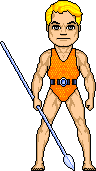  |
Barry Kuda:
1941, Yankee Comics #2 (Harry A Chesler). No, really. "Barry Kuda."
He is a water-breathing hero in the Aquaman mold." He helps Merma
in its fight against "the neighboring midget kingdom" and other threats. He is helped
by his pal Algie. Their power as well as those others under the ocean is limited to the specific area under the ocean as it comes from local coral reefs that release "oxides" into the water, making the water in that area breathable. |
| |
Jeff Barter:
1941, Bang-Up #1 (Progressive). Jeff Barter and his assistant Ted
Collins are traders in Africa and having the standard adventures
fighting evil and helping good natives. |
| |
Bret Barton: 1945, Sparkling Stars #9 (Holyoke). Barton is a sci-fi hero, flying through space with his crew on an atom-powered ship. Their job is to watch over those that travel off-Earth in search of knowledge, adventure and riches on other worlds. |
| |
Lt. "Smoky " Battle: 1936, Funny Picture Stories v1n2 (Comics Magazine Company/Centaur). Lt. Battle is commander of the army outpost at Wat-wah manned by Gurkha soldiers. He leads them in putting down an uprising of hillmen led by the Red Raider, leading to the bandit chieftain's capture. |
| |
Steve Battle: 1941, Champ Comics #13 (Harvey). Steve Battle is an ace undercover and counter-espionage agent. |
| |
Homer K. Beagle: 1945, Young King Cole #1 (Novelty Press). Homer is a detective who learned all there is to know about detecting from books. So equipped, he quits his job at the honey factory and opens a detective agency. As he's a humor character, he's somewhat successful, but through sheer luck, happenstance and spur of the moment cleverness than any real skills or talent as a detective. |
| |
Tom Beatty: 1937, The Comics (Dell). Beatty is the "ace of the Service" and is combatting the masked criminal and kidnapper known as the Gorgon. He's aided by his young pal Danny McKee. |
| |
Beebo: 1942, Shadow Comics #21 (Street & Smith). Beebo is a lad on Jungle Isle somewhere in the South Pacific. He is raised by actual talking animals Fleet the jet black horse and Cheeto the monkey. |
| |
Sgt. Bell: 1941, Dynamic Comics #1 (Chesler). Bell is an American ace flying with the R.A.F. at a secret base in in Egypt. Because of his daring and skill he's nicknamed the R.A.F. Demon though the name isn't used as a code-name or anything. He sports a pencil-thin mustache but not much else to distinguish him. In a later story, he seems to be out of Egypt and is revealed that he is normally a captain, but is demoted for purposes of the mission. |
| |
Edison Bell: 1940, Blue Bolt Comics v1#1 (Novelty). Teenage boy inventer and builder. When he and his pal Jerry started out, they were younger and he was able to invent things like a robot, a rocket car, and able discover how to smash the atom. By the end of the decade, he was decidedly teen-age and put together things like a bicycle garage (in 4 Most). Just goes to show, it doesn't pay to peak too early. Whatever his project was, he always seemed to attract the attention of very bad men. |
|
Blast Bennet: 1940, Weird Comics #1 (Fox). Space adventurer,
he and his pal/ kid sidekick Red travel through space in their
fast spaceship. |
| |
Norge Benson: 1941, Planet Comics #12 (Fiction House). Norge Benson is a “Wrong-Way Corrigan” of space and finds himself on Pluto, a planet of ice and snow and some Earth-like inhabitants. Such as the Penguines aka Plutocrats who are advanced penguin like “people”. And, there's his pet polar bear Frostling. Adventures and hijinks ensue. |
|
|
Bert and Sue: 1946, Super-Mystery Comics v6n1 (Ace). A pair of romantic amateur sleuths in the manner of William Powell and Myrna Loy's Thin Man performances down to the pencil thin mustache. |
| |
Bigbrain Billy: 1946, Calling All Boys (Parents' Magazine). Bigbrain Billy is billed as the smartest boy in the world. He lives in the city of Midvale and may be called to duty from Mayor Whetstone on down. In addition to being smart and clever, he shows quite a bit of bravery as well. |
| |
Bill and Davey: 1938, The Comics (Dell). Bill is a big burly sailor and Davey is a little kid and they are aboard the Lady May, captained by the villainous Captain Lash and his right-hand man and knife-fighter Pedro as well as the rest of the crew of cut-throats. They are after some treasure that the pretty Miss Trew seems to know about who's also along for the ride. Miss Trew thinks Bill is the bravest, noblest man she's known which pleases the tough sailor to no end. |
| |
Bingham Boys: 1941, Silver Streak Comics #15 (Lev Gleason). Billy and Bobby Bingham and buddy Specs (as he wears glasses) are three American boys living a life of adventure following their adventurer friend “Dusty” Travis around the world. |
|
|
Bird Man/Birdman:
1940, Weird Comics #1 (Fox). In the American Southwest, this young
Indian man flies and the keen senses of a bird of prey. The only
clue to his origin is in the text that claims his lineage as a descendant
of an ancient Indian god. In most of the pics, it seemed to me that
his wings were black, but then it could be artistic license. He's
armed with bow and arrow and knife and a skilled fighter with and
without his weapons. The time period of the early stories are ambiguous
but by issue 4, he's clearly in the present day and the wings are
definitely white. They are also more like angel wings, sprouting
from his back as opposed to being attached to his arms ala the Black
Condor. That issue also claimed that his ancestors lived for many
centuries on a bleak island in the North Atlantic. Issue 3 or 4
(I don't have issue 3 to read) seems to be an issue where the looks
of several characters changed, Blast Bennet went from a brunette
in a blue miliary style suit to a blondish redhead in green, and
the foe of Voodoo Man, Bob Warren lost his dashing dark hair and
mustache to become clean-shaven and sandy-blonde with a new assistant
and no girlfriend. |
| |
Black Ace: 1941,
Four Favorites #2 (Ace Periodicals). Captain McRae, an American Flyer with the British R.A.F. His plane has the Ace of Spades painted on the side. |
|
|
Black Angel:
1941, Air Fighters Comics #2. Sylvia Manners lives in an ancient
English castle and is a delicate young woman, prone to things like
feeling faint from the least bit of excitemnt. Secretly, when she's
needed, she goes into an underground hangar, puts on a skin-tight
black costume, and flies a special plane against the Nazis and whatever
strange dangers they throw her way. She frequently works with the
dashing hunk "Black Prince," Colonel Prince of the RAF. |
| |
Black Arrow: 1940, Green Giant #1 (Pelican). Rex Norton is the Black Arrow, a heroic pilot. There is nothing particularly black about him, his costume is standard pilot gear and brown. His plane is a red seaplane with a long black arrow painted on the side. The plane is ill-suited for battle as it means he must fire a machine gun from the cockpit. |
| |
Black Bloch: 1941, Wings Comics #5 (Fiction House). Presumed dead, the Skull Squad find themselves in occupied France. They meet up with Count de Chambreau, former pilot of the French Air Force. He had managed to save his plane, a bloch bomber as well as hundreds of gallons of fuel. What he needs is a crew which is where the Skull Squad come in. They fly several missions, making a name for the painted black bomber. Eventually, the Nazis track the plane to its secret hangar and they fly back to England. |
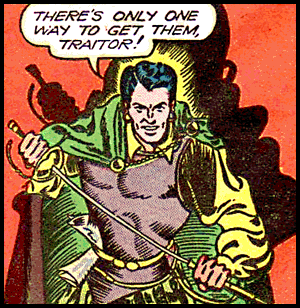 |
Black Buccaneer:
1944, Blazing Comics #1 (Enwill Publishing). Jeffrey Scott: fencing
instructer at Versailles, a spy and the legendary privateer, the
Black Buccaneer travelling the seas in his black ship, the Raven.
His number one man is Boris and he's sometimes helped by his brother Ronnie. |
| |
Black Bull: 1948, Prize Comics Western #71 (Prize). “The early days of the southwest rattled with road bandits and cowhand gunfights over boundary fences, water holes, and salt licks, but a mysterious masked rider, the Black Bull, played a lone hand to help those in distress and maintain law and order.” The Black Bull is Dale Darcy, son of Cornelius Darcy, rich cattle baron of the Triple X Rancho. Dale plays the role of a useless wealthy fop as cover for his dark clad heroic identity... that sounds familiar. Created by Dick Briefer. |
|
|
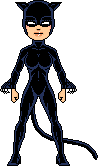
Black Cat: 1941,
Pocket Comics #1 (Harvey). Linda Turner is one of Hollywood's biggest
and most glamorous stars but is bored of that life. Daughter of
a stuntman, she trains to become an expert in judo and fights crime
secretly as the Black Cat. She takes in the orphan Kit Weston and
makes him her sidekick, Kitten. She also has a pet white cat that wears an outfit that turns her into a black cat when helping Black Cat out. Although, her origin had her taking inspiration of her pet black cat Toby. |
|
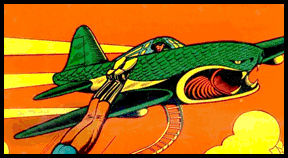
Black Cobra I: 1941, Dynamic Comics #1 (Dynamic). Jim Hornsby is the son of the District Attorney and works as a clerk in his father's office. His father dismisses him as having no ambition and being a "panty-waist", but in reality Hornsby uses the inside knowledge to fight crime as the Black Cobra. His costume is very different than the later version of the character including a cobra like headgear. In a later story his costume is all black-blue and his younger brother Bob is the Cobra Kid. On the cover of #10, it shows the heroes having a stylized plane though nowhere in the comic itself. Their dad is so disappointed in them and trying to get them to take action, to the point that it looks like he's trying to get them killed.
|
|
|
Black Cobra II: 1954, Black Cobra
(Ajax Farrell). The Black Cobra would later get his own series, the company now calling itself Ajax Farrell. He would prove
to be an inconsistant character, there. In one adventure, his
costume contained bullet proof plastic (although an unexploding
shell from a tank would knock the wind out of him). In another,
as the Black Cobra he apparently had some superpowers and ran
into trouble when a secret chemical formula kept him from being
able to change. His secret id in these stories was Steve Drake
and worked for the FBI who worked with an office boy that was
Cobra Kid. Note: Ajax-Farrell and Four Star are possibly the same company. |
|
|
Black Commander:
1941, Air Fighters Comics #1 (Hillman). Barry Haynes is a devil-may-care
pilot who is sentenced to death by firing squad for treason. However,
it's a plot for him to uncover the real spy ring and his escape
is engineered. He escapes but is shot down by the Germans, who capture
him and alter his looks so that he can work for them as a German
agent. Unfortunately, the British Chief of M.I. , the only man who
knows the truth about him has been captured. Haynes steals an experimental
plane, the Black Commander and fights the Nazis, but must avoid
the allies as well until he can prove his innocence and loyalty. |
|
|
Black Crusader:
1941, Red Dragon #6 (Street and Smith). When his father is killed
by the head of the Gestapo known only as #1, Joe Mills dons an all
black costume save for the white cross (one vertical and two horizontal
lines) to hunt him down. The Black Crusader has one special weapon,
a quick drying plastic spray that allows him to cast instant masks
and become a master of disguise. NOTE: The above comes from the
one story that I've actually read. Other sources give a very different
background and I cannot personally verify at this time. |
|
|
Black Diamond:
1949, Black Diamond Western #9 (Gleason). When his family is slain
by outlaws, Bob Vale adopts the masked identity of the Black Diamond,
doing his Lone Ranger thing in the Old West. Like his pulp forebears,
he had a habit of leaving a token, a playing card of his namesake
suit. and eventually became an official U.S. Marshal, possibly the
only masked one in history. His horse is Reliapon and sidekick is
circus strong man Bumper. |
|
|
Black Dwarf:
1945, Red Seal Comics #14 (Harry "A" Chesler). Shorty Wilson
abandons professional football in order to use his athletic skills
fight the underworld. He is aided in his endeavor by a group of ex-crooks: his girlfriend
and crack shot Arsenic Gayne, explosives expert Nitro, Dippy the pick-pocket, and a human fly
they call the Human Fly. NOTE: Hero and his crew were re-named and repackaged as the Blue Monk. |
|
Black Friday: 1942, Cat-man Comics #8 (Holyoke). Military Intelligence Officer Lee Ainsley is gunned down and reported dead. However, an un-named doctor saves his life, fakes a death certificate and gives him a new face and he's now a secret secret agent known as Black Friday as he brings bad luck to the enemies of America.. |
|
|
Black Fury:
1941, Fantastic Comics #17 (Fox). After gangsters killed his newspaper editor father, Daily Clarion gossip columnist John Perry vows revenge when the police won't do anything. To this end, he puts on a costume to fight crime as the Black Fury. He had been the Black Fury long enough to make a name for himself when detective Marley is slain and he takes his son Chuck as a sidekick. Their recurring foe was the Fang for most of their adventures. In issue #22, it looks as if he gets a girlfriend in Bess Vane of the Narcotics Squad and comic relief in a plump hotel detective with the nickname of Satch. NOTE: The Black Fury and Black Lion are remarkably similar characters, from their costumes down to each one facing a master criminal almost their entire runs. (The Blitz and Fang respectfully). |
|
|
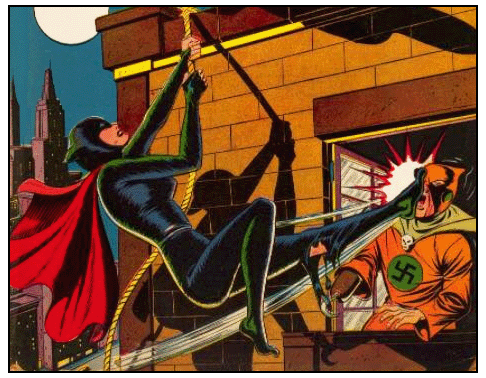
Black
Fury/Miss Fury: April 6, 1941. The Black Fury (comic strip distributed
by the Bell Syndicate). Like many superheroines and a few male superheroes, Marla
Drake originally planned on attending a costume party only to end up becoming a hero when stopping the crime. The skintight catsuit was left to her by her uncle and is reputed to have magical powers. While
she normally doesn't seem to have any powers beyond regular superheroic athleticism
and fighting ability, the costume is supposed to grant the wearer luck. However, she is warned by friend Albino Joe that such things come at a cost. She eventually tries to avoid wearing the costume, fearing that for every bit of good luck it grants, it will deliver bad luck in equal measure which her love life seems to attest. Her former fiance ends up marrying her arch-enemy, Baroness Erica Von Kampf, and fathering a child. Marla rescues the child and adopts him without ever knowing his parentage. Interestingly, while she and the Baroness often worked against each other, the only time they actually met and fought was in a situation where neither knew who the other was. Note: Originally called "Black Fury", she soon
was called Miss Fury. The Miss Fury strip ran until 1952. Her strip
was reprinted by Timely Comics for several years. Created by Tarpe
Mills, one of the few Golden-age female creators and one of the few of either gender to successfully transition from comic books to comic strips. Before Miss Fury, Tarpe Mills created characters for Centaur Comics such as the Purple Zombie.
|
|
|
Black Fury III:
1941, Super-Magic Comics #1 (Street & Smith), Adventurer
Rex King lives in the jungle with Kato, his faithful black panther.
When danger threatens the adopted home he loves, he puts on a costume
that allows him to glide and protect his peaceful jungle home from
a variety of evils. He eventually travels to the Far East and becomes
a thorn in the side of the Japanese. NOTE: It looks like Rex only
went by the name of the Black Fury in his first outing. After that,
the strips and even his enemies just called him by his name. The
one story I've read with him in costume, his legs are bare and his
faithful black panther has a white star on his/her forehead and
goes by the name "Jet". |
| |
Black Knight: 1940, The Funnies #47 (Dell). During the Middle Ages, the Black Knight was a young smithy who loyally served King Victor and saved the king from assassination and killing the traitor. The king secretly knights the lad and he becomes the mysterious Black Knight. In issue #54, he comes across a group of Foresters in the King's Evergreen Forest. The Foresters are the poor and common folk that are allowed to hunt in the forest but are being harried by poachers who are wantonly slaying the animals. They are lead by Peter, a superb marksman and who carries the longest and strongest bow. After defeating the poachers, Peter joins the Black Knight. |
|
|
Black Lion:
1941, Wonderworld Comics #21 (Fox). George Davis is one of those
big game hunters who decides hunting criminals would be more challeging.
He is helped by his teen sidekick Cub who is in reality his nephew Larry. Over the course of their 6 issue run, they fought the villainous Blitz. It's hard to tell by the size of the graphics, but while the Black Lion's chest emblem is that of a lion's head, Cub's is appropriately enough of a cat without a mane, a lion cub. |
|
|
Black Orchid: 1944,
Tops Comics (Lev Gleason). Diana Dawn is secretary to D.A. Richard
Day. Thanks to a magic ring, she's also the mysterious sleuth Black
Orchid. The ring releases black paralyzing gases. She also carries
a gun. |
|
|
Black Orchid: 1943,
All-New Comics #2 (Harvey). Judy Allen and Rocky Ford are partners
in a detective agency, although Ford is chauvanistic enough to try
to keep Judy out of the way on cases. What he doesn't know is that
Allen is in reality the heroine the Black Orchid. Likewise she's
unaware that the hero the Scarlet Nemesis who she frequently works
with is Ford. |
|
|
Black Owl (I & II):
1940 & 42/43, Prize Comics. Bored Playboy Doug Danville first adopted
the identity of K, the Unknown. After one outing, he became the
Black Owl and frequently helped his private investigator girl friend
on cases. Deciding to go into the service over seas, he passed his
Black Owl identity to Walt Walters who had recently discovered his
sons were the kid heroes Yank & Doodle and decided to use the Owl
identity to keep watch over them. Walters developed a flying owl-ship
to aide him in his battles against crime. Note: his flying
ship is very similar to the later Ted Kord Blue Beetle's flying
bug. And Blue Beetle was used as inspiration for Nite Owl I & II
in Watchmen, and Nite Owl II had a flying owl-ship. |
|
|
Black Panther: 1941,
Stars & Stripes #3 (Centaur). Little is known today of this character.
But at the time of his one published case he was well-known enough
to be instantly recognized and feared by his foe. No known powers. |
| |
Black Phantom: 1948, Return of The Black Phantom (Vital
Pubs). In a dark business suit, gloves, and hooded cloak, Roy
Dare is the Black Phantom.�NOTE: A small giveaway comic packaged
with Fleer bubblegum. |
| |
Black Raider(s): 1944, Power Comics #3 (Narrative). Gordon Summers and Red Crandall are ex-commandos and decide to use those tactics and fight crime as the black clad Black Raiders. As a duo, they are referred to as the Black Raiders, plural. However, the name of the strip is the Black Raider, and crooks seem to regard Gordon as THE Black Raider, singular. However, Red is the one who has the way with the ladies, too many for him to even keep their names straight.
Mask Comics gives their origin. Gordon Summers and Harold “Red” Crandall are Army Rangers of the Black Raiders. They are part of the invasion force of Normandy and are wounded some time after as they make their way towards Germany. Against their wishes, they are medically discharged but find civilian life is now tame and dull. Witnessing a brutal crime only to see the crooks released on bail and the D.A. refusing to try the case, Gordon decides to use his all-black rangers outfit and a mask to fight the war at home. His departure to track the criminals is observed by Red who puts on an identical costume. |
| |
Black Rider:
1941, Weird Comics #17 (Fox). Decked in black with mask, Jack Cody
is a modern western cowboy riding his horse Black Devil. |
| |
Black Sheep Squadron:
1941, Air Fighters Comics #1 (Hillman). From battle torn countries
over the world come the men who make up the the toughest squadron
in the RAF of Britain. They are headed by the tough as nails Captain
Logan Black.. |
|
|
Black Satan:
1941, Yankee Comics #1 (Harry "A" Chesler). "A district attorney
during the daytime, Harold Flynn adopts the role of the dreaded
Black Satan for his nightly crusade against crime" runs the description
on the first page of his adventure. Interestingly he has a mustache
on the splash page but nowhere else. He carries a special gun that
can blind his foes. |
|
|
Black Spider:
1940, Super-Mystery Comics #3 (Ace). D.A. Ralph Nelson belongs to
that subset of mysterymen who are lawyers by day and costumed vigilantes
by night. His shtick is large black spiders he keeps to terrorize
crooks, because they are a cowardly and superstitious lot. He's
assisted by his secretary Peggy Dodge |
|
|
Black Terror:
1941, Exciting Comics #9 (Better Publications). Pharmacist Bob Benton
is inspired by the incredible strength of ants and invents a formula
of "formic ethers" that gives him superpowers. The Black Terror's
powers were the generic superstrength and being bullet proof though
susceptible to blows to the head. He uses these to fight crime and
the Axis powers. His sidekickTim Roland wears the same costume and
has the same powers. His girlfriend is Jean Starr. For most of the
characters' run, Tim was one of those sidekicks that seemed to go
by their real name. However, in his last outing (and his only sole
outing), he's known as Kid Terror and in Black Terror #24 he's referred to as the Terror Kid, though whether that was meant to be an actual name vs. a description as in "those meddling kids" is unclear. The character was briefly wonderfully
done by the team of Mort Meskin (Vigilante, Johnny Quick) and Jerry
Robbins (Batman). During that time, the duo showed no indication
of superpowers. |
| |
Black Terrors of Mexico: 1947, Black Terror #20 (Standard). In the little town of Teoquita, Mexico, Porfirio Juarez Rivera and Miguel are so inspired by a Black Terror film they found in a movie projector, that they decide to dress up as the Terror Twins to fight off and scare the desperados. Even though he has a mustache, talks with a Spanish accent and wears a sombrero, spurs and sash instead of a belt, and his sidekick has dark hair instead of blonde, they are mistaken for the real deal and reports bring the real Black Terror down to investigate. The duo's hearts are in the right place so they are allowed to keep their uniforms, with an admonition to be careful when they wear it, implying that they may continue in some capacity as the Mexican Black Terrors. NOTES: It's interesting to note, that in this story when the two duos confront some crooks, they claim they see FOUR Black Terrors, implying that Tim/Kid Terror is sometimes also called the Black Terror. I've covered faux-heroes in the villains side, bad guys that disguise themselves as the heroes, but it's the first I've found for this site, a faux-hero dressed as the hero in order to do good. And, this may be significant. The Batmen of All Nations/Club of Heroes wouldn't debut until 1955. So, this may indeed be the very first time that a story has a hero inspiring someone to take on a near-duplicate identity, especially one of another nation. |
|
|
Black Venus:
1944, Contact Comics #5 (Aviation Press). Mary Roche is a physical
therapist who puts on a costume to go after crooks who pick wounded
and disabled veterans. She's a good fighter and ace pilot with her
own special plane. |
|
|
Black Widow:
1941, Catman Comics #1 (Holyoke). After the murder of her husband, Linda Masters adopts the identity to hunt criminals. She carries and uses a gun. |
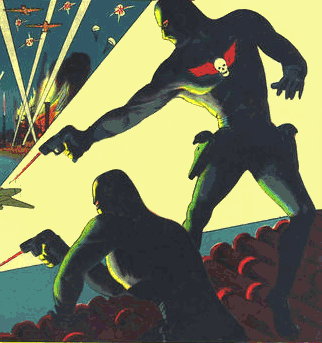 |
Black Wings:
1941, War Comics #4 (Dell). British commandoes dressed head to toe in black costumes. There
are at least 9 agents as the one story I've read deals with agents
5 & 9. See Night Devils for more info. While the cover had the skull and wings symbo on the chests, the costumes were all black in the stories. |
|
Blackbird: 1941, Blue Beetle #9 (Fox). Jake Baxter is the inventor and pilot
of his own special airplane and is the heroic Blackbird when trouble
arises. He's helped out by his mechanic Raftery (sic). |
|
|
Blackout: 1941,
Captain Battle #1 (Comic House Publications). Basil Brusiloff is
a scientist in Belgrade when his lab is bombed by the Nazis leaving
his body pitch black and with fantastic powers. While some sources
claim he becomes covered in hair, but the text makes it clear that
it's just his skin that has been darkened, nothing about being given black fur. The art does seem to imply a more hirsute than normal body after the explosion, though. Maybe they shied away from having a naked hero? |
|
|
Blackout II:
1942, Catman #10 (Holyoke). Jack Wayne is a more conventional hero
than his Western European namesake. He and Pop Simms are American correspondents in Germany when they are taken by the Gestapo for questioning. Tortured with a whip, Pop is killed and Jack is scarred and blinded. He fights his way free and a kindly hunchback takes him to see Dr. Dismal and his secret laboratory underneath Gestapo headquarters. Despite his super-villain style name, Dismal ascertains that the reporter's optic nerves aren't totally dead and manufactures special goggles that allow him to see by magnifying the light into his eyes. He finds that Dismal is the head of a German Underground, victims and native Germans who hate the Nazis. Dismal must wear a metal skull cap as his skull had been shattered while the hunchback had also been a victim of the Gestapo's whips which left his face with a perpetual tortured smile. Jack Wayne stays with them and the rest of the Underground as a nemesis of the night, the hero Blackout. Later, it's called the Underground Society with Blackout as one of the chiefs and top operatives. In issue #22, when he confronts Baron Von Richtofen II, he claims to have flown with his father in WWI FOR Germany and his father was an honorable man unlike junior who took joy in gunning down women and children. |
|
Blackstone: 1941, Super-Magic Comics #1 (Street & Smith). Blackstone is a stage magician who gets involved in mysteries and adventures, requiring his knowledge of magic tricks, escapes, hypnosis and sometimes tricks that go unexplained and look like real magic. Unlike many comic book heroes, he's middle-aged in appearance with white hair. His assistants are Rhoda and the Indian Pundab. NOTE: Harry Blackstone was a real and famous stage magician and friend of Street and Smith's Shadow writer Walt Gibson. His fictional adventures were published also by E.C and Marvel. See Dr. Neff for another character by Street & Smith based on an actual person. |
| |
Tim Blain: 1940, Super Spy #2 (Centaur). Tim is a tough-as-nails p.i. in California. |
|
|
Inspector
Blake: 1940, Whirlwind Comics #1 (Nita).Super-sleuth of Scotland
Yard. |
| |
Blanda: 1940, Miracle Comics #1 (Hillman). Blanda is a white Jungle Queen. In this cse, she really is, she rules a tribe that is called the Azas that worship the animals. To the point that they and Blanda engage in sacrificing their enemies and hunters to lions. She's strong enough to defend her right to rule by combat. She falls for a visiting white hunter named Greg Martin, who decides to stay with her in the jungle. There's also a local group of gorillas that are very intelligent and loyal to Blanda |
|
|
"Blaze" Baylor:
1941, Catman Comics #1 (Holyoke). "When the famous fire chief `Smoky'
Baylor is killed in an incendiary fire...his son vows vengeance
and dedicates his life to the task of tracking down all who profit
from the crime of arson." Blaze does this with a fireproof and bulletproof
costume and a special "gun" that is both flamethrower
and fire-extinguisher. He's also helped by his assistant Chuck, a taxi driver. |
| |
Blaze, Dick: 1940, Whirlwind Comics #1 (Nita). Four Letter athlete at Yardley having the usual adventures. Second issue, he takes up fencing and gains a letter. |
| |
Blazing Scarab: 1939, Champion Comics #2 (Harvey). Archaeologist Walt Worthington
discovers a magical blazing scarab in a hidden tomb in Egypt and
it transports him and his servant Snowball to a magical city called Baracs ruled by an evil Egyptian priest of Set named Oo-Lhat who had been there for centuries. With Walt, he is able to re-establish the broken link between Baracs and our world where they can raid for supplies and slaves. Leaving Walt and his servant behind Oo-Lhat leads a group back to our world for conquest. Walt and Snowball find they are not alone though, as they discover the women, worshippers of Isis. Walt falls hard for the lead priestess of Isis and Snowball for another of the women. The Priestess is convinced that they are there to liberate them and lead them back to their homeworld. Eventually the blazing scarab reaches maximum brightness and the two heroes and women travel back through the portal it opens. Only Walt and Snowball find themselves alone amidst a field of skeletons, that upon travelling back, the women (and presumably Oo-Lhat's forcres before them) aged to their true ages. Thus ends the story of The Blazing Scarab.
Snowball is sadly done as the typical racist caricature. |
| |
The Blitz Buster: 1941, Four Favorites #1 (Ace). Major John Chalmers is an expert at make-up and impersonation. He uses these skills on behalf of the US Secret Service to take aid in US interests across the lines even though the country is not officially at war yet. The moniker of "Blitz Buster" is not a code-name but an honorific he is toasted to as after helping smash a German blitzkreig attack. |
| |
Blond Garth:
1940, Colossus Comics #1 (Sun). Blond Garth is a one of those
popular Tarzan clones, this time apparently in the South Seas.
He was a young lad, washed on the shores of the island clinging to a water cask, the sole survivor of a shipwreck. He was raised by by the Rangipu tribe's medicine man Bubu, who taught him wisdom until he grew up to be a mighty hunter, swimmer and good with spear and knife. He was in love with the chief's daughter Tara but was plotted against by the evil Draca, priestess of Iktas and in league with Cimbaru, an enemy tribe on another island (because he apparently had spurned Draca's daughter). Cimbaru finds a giant shark and releases it in the waters near the island of Rangipu where it kills the chief's son and he dies of grief. The island is dependent on the pearls to trade for food and the islanders find themselves isolated, bereft of king and threatened with starvation if they don't leave. Draca then works up the tribe against Garth, claiming him to be a golden devil hated by the gods. Sacrificed to the giant shark Malie, he places a giant shell in its mouth, prying the jaws open and battles tirelessly for an hour until killing it. Finding also an horde of pearls, he is declared "King of the Isles." Having fallen into the waters at the start of the sacrifice, Draca is presumed drowned since the shark itself ignored her scrawny body but no mention is made of her after that point. |
| |
Blonde Bomber: 1942, Green Hornet Comics #7(Harvey). Honey Blake is an ace newsreel camerawoman as well as an expert chemist and a decent acrobat and detective. She gets involved in various crazy adventures along with sidekick cameraman Jimmy Slapso. Not sure why she's called the Blonde Bomber other than being a blonde bomb. |
| |
Jimmy Blue/Johnny Blue: 1940, Exciting Comics #3 (Standard) Originally “Johnny Blue”. Jimmy Blue is a kid cowboy of the Bar 8 ranch and has the usual cowboy adventures. |
|
Blue Beetle:
1939, Mystery Men Comics #1 (Fox). In his first adventure, he wore the suit and mask, no overt powers, and was credited with inventing a small cordless phone that he carried! He kept a suped-up roadster at a hideout secreted at the shop of a local pharmacist named Abe. In his second appearance, he was in the more familiar blue chainmail costume only it was short-sleeved, had antennae and a large scarab drawn on the chest. He also dangled a small blue scarab to spook crooks. By issue 3, he's in his most familiar costume, though still no origin, although it is now referenced that he uses the super vitamin prepared by Dr. Franz. Later, when he actually gets an origin: when rookie cop Dan Garret is
gunned down, a mysterious Dr. Franz decides to help save his life
by injecting him with a super vitamin 2-X. In addition to the vitamin,
he gives him a bulletproof suit and Garret moonlights as the Blue
Beetle. Through it all, his partner Mike Mannigan has vowed to hunt down the Blue Beetle
(elements of an insect themed hero of another color). In one story, we get a reference to Mike's extended family as they refer to a nephew killed in an explosion, indicating siblings or a wife. In his earlier less powerful days, Dr. Franz would help him with disguises and he'd carry skeleton key and such in his belt buckle. He also had a powerful auto and a plane that with a special gasoline could fly much further than other planes of the day. He later briefly gains
a sidekick Sparky. Beetle's powers were originally of the generic
kind, but eventually he had almost any power the story demanded including a black light device that rendered him invisible. His first costume was more pulp inspired, before taking on the more familiar chainmail hooded body suit. |
|
|
Blue Bolt: 1940,
Blue Bolt #1 (Funnies, Inc). One of the more convoluted origins,
Fred Parrish is a Harvard star football player and gets struck by
lightning. He then climbs into a plane to fly for help but crashes
in a valley inside the earth where he's brought into an underground
laboratory where a Dr. Bertoff explains that he survived due to
Bertoff's work and some "radium deposits". He now has the standard
superpowers joins the fight to stop the invasion of the forces of
the Green Sorceress, ruler of a rival underground kingdom. Over
time, he returns to the surface to fight crime and fight in the
war effort. He is eventually partnered with Lois Blake, who has
the same powers that Parrish does. In addition to his powers, he
uses a "lightning gun." Near the end of his run, he seems to have
given up the superhero lifestyle in favor of one as a soldier. He becomes a pilot in the Army. Oddly, it's under the name Blue Bolt and his rank is inconsistant as one story has him as a captain and a later story, he's a lieutenant. One
of, if not the, first teamings of Simon & Kirby, Blue Bolt's design
probably owes more to Simon at this point of their careers.. |
|
|
Blue Circle:
1944, Blue Circle Comics #1 (Rural Home Publishing). In Midtown, inventor Len Stafford fights crime helped by the Blue Circle Council, made
of seven other "past masters in crime" who have received pardons for helping the Blue Circle out. Council members include Mike Tyler, expert in hijacking; Fixer, big time crooked gambler; Frank Craven, who now works at a bank; Saunders, who specialized in crimes similar to theft of a Rembrandt from a museum. As Stafford, he has full force privileges, an honorary member of the police. |
|
|
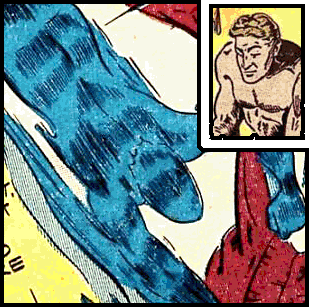
Blue Fire: 1940,
Wham #2, (Centaur).Jack Knapp is a young scientist (from references, in college, possibly a graduate student) and is about to imbibe a potion of his own concoction when a formula explodes. It doesn't do any damage but leaves Jack surrounded in a corona of blue flames. The flames do not burn or consume and Jack soon discovers that it leaves him mostly immaterial. He can gently pick things up and a test shows that he can put handcuffs on, but with little effort, can pull his hands apart and through the handcuffs. As this makes him bulletproof, he decides to fight crime. As he faces his first opponent, a frozen saboteur calling himself the Frost, he discovers that the powers have a drawback. He cannot be shot or punched, but likewise he cannot punch his opponent.
The powers fade after about two hours, so Jack has made a supply of small bombs made from the formula to power up when needed. He has some foreign language skills and his father has some pull with either the authorities or the shiplines as Jack is able to get a pass to investigate the strange acts of sabotage aboard some ships. An interesting nod to another feature by the artist, the skiff that Jack takes to the ship is called "The Shark".
In the text story in the same comic, Jack is called Dick. |
 |
Blue Flame:
1947, Captain Flight #11 (Four Stars). Another Human Torch riff,
we don't get an origin or name. When not on fire, he sorta looks
like a grown up Toro,clad only in blue trunks and boots.
In his single adventure, he fights a crafty jewel thief S. Aitan. He shifts between his flame and human form alot and with relative ease, but apparently not preferring to be on fire if he doesn't need to be such as fighting an unarmed man hand to hand. Could be he doesn't have as fine control of the heat of his flames as other torches, hence he always burns blue, and it's either all on or all off. |
|
|
Blue Lady: 1941, Amazing-Man Comics #24 (Centaur). Lucille
Martin, an adventurous novelist, was returning from a trip to
China when she is asked by Lotus, a Chinese woman and aquaintanc,e if she'd take possession of a statue, and deliver it if anything happened to her. In payment for the favor, Lotus gives Lucille a ring with a bluebird on it, that supposedly grants powers to its owner. Inspecting the ring, Lucille breaks it, accidentally releasing and breathing in some gas released from
the ring which gives her some super powers (just strength at first but others manifest themselves later). She makes a costume, including the figure of a blue bird on her cap and becomes a mystery-woman carrying out her vow to Lotus as well as helping her fiance Larry Grant. As the Blue Lady, she has many powers, able to appear and disappear
in a mist (and use the mist to hide her), super strength and invulnerability,
though vulnerable to gasses. |
|
Blue Monk: 1948, Crime Reporter #1 (St. John). Stubby Watson is a shorter than average man who fights crime as the dreaded Blue Monk. The Blue Monk leads a crew of ex-crooks: 3 men by the names of Gypo, Scorpion, and the Human Fly, and a sultry woman named Satana.
Note: This is a repackaging of the hero the Black Dwarf only with names changed. |
|
|
Blue Streak (I):
1940, Crash Comics #1 (Holyoke). "Defender of the People" and the
"self-appointed foe of ruthless dictators". He goes about his
business with the aid of his oriental chauffeur and friend Tago. In the first story, it's revealed that at the start of war in Europe, he built a secret lab in the US in a valley surrounded by the mountains as a safehouse for the world's great inventions inventions. He rescues Dr. Ruger, a noted scientist from a ruthless dictator and sets him up there. In another he shows that he's strong enough to bend iron bars though in comics that doesn't necessarily mean superhuman strength, just top physical condition. Despite several sources (including this one until made aware of the fact) giving his name of Don Vin, his real name is not revealed though we do see him at home with Tago. Despite taking down various dictators, I guess Hitler and Stalin manage to slip through the cracks. |
|
|
Blue Streak (II):
1945, Headline Comics #13 (Prize). Jim Dare is an aeralist. When
gangsters kill his son, he uses his skills to become the Blue Streak
to track them down. An interesting turn of events, his acrobatic
skills are to the degree that people at one time assume he can fly. |
| |
Bob and Bill:
1940, Crackajack Funnies #26 (Dell). "...the Scout twins when exploring
a great cave were caught in an underground landslide and carried
to a strange world of giants and very tiny people below the Earth's
surface. |
|
|
Bogey Man: 1945,
Red Band Comics #1 (Enwil). The Bogeyman is a Spirit riff with the
addition of a mustache. In reality, he's Kendall Richards, a mystery
writer who is such a big help to the police that gangster Rusty
Blade decides to rub him out. Richards proves too tough for Blade's
thugs, but they manage to swipe his manuscript for his next book
which includes how to commit the perfect murder. Of course Blade
has his thugs follow it. Richards knows what's coming so manages
to avoid death but without the gangsters realizing it. So he adopts
the id of the Bogey Man to take on the Blade and his thugs. The Yellowjacket had a plot with a similar story. |
| |
Bold Buckeroo: 1948, The Texan #1. Tim Rollins is the Bold Buckeroo and is wanted by the Law in the Old West even though he's in reality a good man and foe of crime. Despite being wanted, he doesn't wear a mask or disguise his features. |
| |
Speed Bolton: 1937, The Comics #4 (Dell). Speed is the “ace pilot” of Allied Airlines and his pal Wings Dale is his co-pilot. Betty Clair is Chief Hostess. |
|
|
Bombshell: 1942,
Boy Comics #3 (Lev Gleason). On the planet Mars, the god Mars has
grown disgusted with the Nazis who have turned war into a mindless
slaughter. Impressed with the skill and bravery of his son, Bombshell,
he sends his son to Earth knowing that once he's made the trip he
cannot return. He sometimes teams up with Young Robin Hood. He has
a magic sword which won't harm humans but will cut through most
anything else and an indestructible shield. While we are supposed
to believe that it's the god Mars, the story reads as if this Mars
is a king of a civilization on Mars. |
| |
Bonnie: 1944, Power Comics #2 (Narrative). Bonnie is a true Scottish lass who talks in a highlands brogue. She somehow manages to play swinging music on bagpipes. And, when crooks Slick and Greasy hide money in them and try to take the bagpipes from her, they discover that she is more than able to handle both of the. She claims that if she knew it was just the money they were after and not her bagpipes, she wouldn't have fought half as hard. |
| |
Boomerang (I): 1944, Terrific Comics #2 (Et-Es-Go Magazines).
Lloyd Raleigh joins U.S. Army Intelligence as a captain where
he undertakes special missions against the Axis powers. He is
also secretly the Boomerang, a man incredibly gifted with the
use of the weapon of that name. His girlfriend Diana finds out
his secret identity and reveals she was England's champion archer
before the war. Not long before she adopts a similar costume to
his and is skewering foes with arrows but goes by her regular
name. |
| |
Wings Bordon: 1940, Whirlwind Comics #1 (Nita). King of the airways, an ace pilot undertaking special jobs for the government such as flying a top secret plane desired by the foreign powers across the country. |
| |
Bos'n Hal, Sea Scout: Popular Comics (Dell/Bell Syndicate}. Adventurous young sailor lad, bosun to Admiral Jones. His friends are Dawn and Ted. The admiral buys a dirigible and soon puts together a crew to go on an expedition that's part rescue mission and part treasure hunt. By Lt. Commander F. V. Martinek and L. A. Baroth, the creators behind Don Winslow. |
|
Bouncer: 1944,
The Bouncer #11 (Fox). Sculptor Adam Antaeas, Jr. creates a statue
of the Greek "god" Antaeus that magically comes to life when danger
threatens. When that happens both Adam and the statue possess super-strength
and the ability to bounce like a rubber ball, knocking opponents
out. Like the mythical Antaeus who was vulnerable when separated
from the earth, the duo are vulnerable when in mid-bounce. |
| |
Clem Bowers: 1936, Detective Picture Stories #1 (Centaur). Clem Bowers is a clever, tough, cigar smoking detective. He's helped by Patrolman Donovan. |
| |
Prop Bowers: 1947, The Saint #1 (Avon). Prop Bowers is a freelance pilot whose jobs naturally take him all over and embroil him in various adventures. Bowers is helped by secretary and girlfriend Delia. |
| |
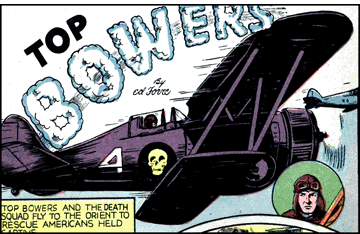
Top Bowers: 1944, Captain Flight #4 (Four Star). Top is an ace pilot and part of the Death Squad who seem to have a bit of autonomy ie may not be reporting to any official chain of command. The only other pilot mentioned by name is Jimmy. Bowers' girlfriend is Wendy who apparently travels with him on some missions. For some reason, Top and his men pilot bi-planes even this late in the War.
|
| |
Boy Champions: 1944, Green Lama #1 (Spark Publications). “Do you need someone to mind the baby? Or find an invisible boojum? Or walk your dog? The Boy Champions are at our service! They’ll do anything...for a slight payment!” Lads red-headed Mickey, erudite Wellington Smith, and Brooklyn slang talking Tuffy are the enterprising Boy Champions. |
| |
Boy Explorers: 1946,
Boy Explorers Comics #1 (Harvey). Mister Zero, Gashouse, Smiley
and Gadget are orphans, one from America and three from European
countries. They travel around the world in a Yankee Clipper skippered
by their pal, the short grizzled redhead Commodore Sinbad. They
have no powers but are doughty adventurers nonetheless. |
| |
Boy Heroes:
1943/44 All-New Comics #6 (Harvey). Another kid-gang, this time
it's Corny, Punchy, Trigger, and Prince (an actual Dutch prince)
who decide to join together to help the war effort having adventures in war torn Europe. |
| |
Boy King:
1943, Clue Comics #1 (Hillman). Centuries ago, Nostrodamus creates
the "Giant", a large statue, as a secret weapon for the
defense of Swisslakia. When Nazis invade and kill the ruling king,
young prince David activates the statue which comes to some semblance
of life. Boy King and the Giant take a boatload of surviving Swisslakians
to America from where he'll help fight the Germans, one of his chief
foes, the Crane. In America, he comes across his twin brother Muggsy,
a leader of Hell's Kitchen gang of children. Boy King is not averse
to using a gun or knife if the situation demands it but he's good
with his fists in a fight. |
| |
Boy Magician: See Merlin. |
| |
Boy Rangers:
1943, Clue Comics #1 (Hillman). In matching sweat shirts, Jackie
Law along with Buck, Corny, Froggy, and Gorilla were the Boy Rangers.
On occassion, they also made use of a giant robot that they controlled
from inside. |
| |
Boy Rangers (II): 1942, Devil Dogs Comics #1 (Street & Smith). Randolph Cartwight Swift Jr aka Speed, Rocky, and Chris want to be Rangers though at the moment they are too young. So, they do their part by fighting crime in their hometown and are reward with Rangers' uniforms by the mayor. NOTE: Written by Walt Gibson and drawn by Jack Binder. While the comic takes its name from the Marines, two of the strips reference the Army Rangers. |
| |
Betty Boyd: 1944, All Good Comics #nn (Fox). Betty Boyd a tough reporter and carries an automatic in her purse that she's not above using to deadly effect.
|
| |
Jack Boyd: 1946, Future World Comics #1 (George W. Dougherty Publishing). Jack Boyd is an adventurer and expert on radar and sonar. He travels by his yacht, the Silver Streak which is outfitted with modern devices. His travels have him using modern technology to fight various criminals, pirates, and kidnappers. |
| |
Boots Bradley: 1947, Cow Puncher Comics #2 (Avon). Boots is the owner of owner of a ranch, who is being bedeviled by underhanded tactics of rivals who try to steal her cattle and destroy her property. She's warned by the handsome new school teacher who gets taken prisoner for his troubles. Luckily, Boots is tough as nails and a good shot with a six-shooter when the occasion demands.
|
| |
Jack Bradley: 1945, Red Circle Comics #1 (Enwil/Rural). Naval commander of a Destroyer and mine squadron, he fights the War in the South Seas |
| |
"Slim"
Bradley: 1939, Amazing Man #5 (Centaur). Slim is a heroic forest
ranger at Spearhead National Forest keeping order astride his horse
Buck. The strip's setting manages to combine the sensibilities of
the Old West with the modern day. |
| |
Buck Brady: 1940, Prize Comics #1 (Prize). Buck Brady is an FBI agent. His first
published case pitted him against his counterfeiter brother. |
| |
Braily of the Tropics: 1936, Funny Picture Stories v1#1 (Centaur). Joe Brailey travels the world in search of adventure and trapping exotic animals. In Africa, he runs afoul of an evil witchdoctor and discovers a young girl living with mandrills, called "the daughter of the apes". He manages to reunite her with her father who had trained zebras to be beasts of burden. The witchdoctor is killed by Chakka, her main mandrill, when the man sneaks into the tent to kill her (he was the one who stole her from her father and left her in the wild in an effort to use her as a way to control natives and her father). Afterwards, Braily soon finds himself teaming up with fiesty Maudie from the hills of India (exotic looking woman but talking with British accent) and her trained tiger Whiskers. |
|
Boom Boom Brannigan: 1944, Prize Comics #44 (Prize). Professor Dennis "Boom Boom"
Brannigan is an adventurous boxer |
| |
Eddie Brannigan: 1936, Detective Picture Stories #1 (Centaur). Detective Eddie Brannigan tracks down Krautz, aka the Phantom Killer. Eddie is tough and determined, pursuing Krautz despite being wounded, but he's not otherwise particularly capable or smart. |
|
|
Bill Breen: 1936. Funny Pages #6 (Comics Magazine Co/Centaur/Chesler). Bill Breen is an adventurer/explorer in Africa. He is joined up by Koko, a native son of a chief who has run away from home. Note: Not sure if this is the actual first appearance, as the story seems to indicate an earlier chapter, but no notice that it had appeared in The Comics Magazine/Funny Pages before this. The strip itself is in rhyme, everyone talks it. The African characters are sadly drawn in what would be considered a very racist manner. |
| |
Bill Brett: 1945, Camera Comics #4 (U.S. Camera). Bill Brett is a newsreel cameraman of Cosmopolitan Newsreel Studios. However, he also has a penchant for getting into and solving mysteries. He's helped by Sue Dale, a reporter/photographer for the same outfit. Their boss is Editor Lee Spence.
|
| |
British Agent 99: 1941, Pocket Comics #1 (Harvey). Alan Douglas is a noted movie star who returns to his native England to enlist in the British Secret Service as Agent 99. He's a master of disguise and languages. |
| |
Terry Britt: 1945, Crown Comics #1 (McCombs). Six masked men dedicated to erasing crime in their city set policemen Terry Britt on the trail of a crooked politician and racketeer. It's unclear exactly how they contact Britt or if Britt even knows he's doing their bidding. |
| |
Larry Broderick: 1948, Young King Cole v3 n10 (Novelty). Larry Broderick is a famous private detective with the unsolved case of his father's murderer hanging over him as he solves other cases. His assistant and leg man is the middle-aged Larkin.He is assisted by his more traditionally detective-like partner Larkin. |
|
Shark Brodie: 1940, Fight Comics #1 (Fiction House). Shark is a two-fisted sailor in the South Seas who gets into all manners of adventures and breaking beautiful ladies' hearts. In issue 17, he apparently has a girl friend who appears in more than one issue, Lily Lamont. Despite wearing a sarong and going barefoot, Lily is more than capable of holding her own in a fight. Note: From the start, the strip is credited to George Aksut. Spelling the last name backwards gives us a more familiar name. |
|
Broncho Bill: 1932, Broncho Bill (United Features Syndicate, Inc)/1936, Tip Top Comics #51 (United Features) Broncho Bill is a young lad in the modern American West. He's a good rider and with guns. In his teen-age years, he goes undercover for the Range Patrol. NOTE: Created by Harry O'Neill, he actually started in 1928 as Young Buffalo Bill, then Buckaroo Bill before settling on Broncho Bill. In 1947, his adventures started being reprinted in his own comic (starting with #5) published by Standard. In issue 11, they do a new story featuring the character as opposed to a reprint which is the Range Patrol story. Issue 12 is back to reprints. |
| |
Bronco Shot: 1947, X-Venture #1 (Victory Magazine). Bill Evans is a two-gun Texan shooter also known as "Bronco Shot". During the War, he served in the US Army with some acclaim as news of his exploits made it down there and afterwards returned to the American Ranch in Argentine where it still looks like the Old West despite the references to modern day. He gets embroiled in fighting some Fascist bandits and reuniting his old friend Mary Cole with her fiance. |
|
Bronze Man: 1945/46? Blue Beetle 42 & 44 (Fox). Major Randy Ronald is an ace
of aces whose face was marred when escaping from the enemy and is
presumed dead by the general public. In reality he goes around wearing
the impassive bronze mask and waging war against injustice. During the War, his wingman was Buzz Smith who becomes a judge after the War and names his son after Randy Ronald. An interesting
gimick, the artist never drew his face front on unobstructed unless
he was wearing the mask. NOTE: In at least one story, he is depicted as having actual powers, being able to leap or fly, inordinate strength, etc. See the Green Turtle for a character with a similar face gimmick. There was also a similar gimmick in the comic strip "Smilin' Jack" where a character was so handsome, women would just swoon at the sight of him and his face was never shown in panel. |
| |
Bronze Terror: 1941, Daredevil Comics #2 (Lev Gleason). Apache Jeff Dixon returns
to the reservation after graduating from law school. Finding his
father has been framed for murder, he puts on a horrific costume
to fight against injustice. His girlfriend is Lily, also a Native
American. In keeping with the title, they are colored more of a
yellowish color ala Asians of the time than the deep red usually
used for Indians. |
| |
Jay Brooks: 1947, Sparking Stars #29 (Holyoke). Jay Brooks is a two-fisted social worker for hire, operating out of Empire City, USA. His specialty is saving kids from lives of crime. |
| |
The Brothers 3: Funny Picture Stories #4 (Centaur). Captain Smith, Baron Carl Von Kirchonen, and Fatts Dugan are three adventurers in French Morrocco. They have a small office and airport at the end of town and bill themselves as The Brothers Three. NOTE: created by Will Eisner. |
| |
Battling Beau Brummel: 1937, Funny Pictures Stories #1 (Centaur). Bob Brummel is from a long line of fighters. In his childhood days, he was considered a champion of the underdog, a modern D'Artagnan and in college he earned the nickname of "Beau" when he laid out the champion with a right hook but never pursued boxing any further. However, he was also considered a fine gentleman in Society. When he stops the taxi in which he and his girl Helen Beresford is riding so that he can trounce a driver for beating his team of horses, she resents it, abhorring headstrong violence. In the crowd witnessing the scene is Ace Martin, a manager of boxing stars and Ruth Porter. Ruth recognizes Bob's face as a young soldier she knew in the War where she had been a nurse though Bob does not place her. He finds himself torn between the two women as he tries to stay out of trouble, but it keeps finding him. Text serial. |
| |
Buck ‘n’ Broncho: 1944, Terrific Comics #1 (Temerson/Helnit). Buck Jordan and “Broncho” Boyd are adventurous newsreel cameramen for Supreme News. Their search for adventure and news stories take them around the world. |
| |
Duke Buckland: Pulp – September, 1934, Western Trails v17 #4. Comic – 1948, Western Adventures #1 (Ace). Duke is is an Old West outlaw hero in that he was framed by his enemies and thus wanted for a crime he didn't commit. He rides the plains with his pal Kit McCane dispensing six-gun justice. NOTE: He first appeared in the Western Trails pulps for six adventures ranging from 1934 – 1937. He was created by Frederick C. Davis who also wrote the Moon Man stories for Ace. |
| |
Ace Buckley: 1940, Startling Comics #3 (Standard). Ace builds a time machine and shows it off to his childhood friend and would-be girlfriend Toni Stark (!). She accidentally turns it on and off they go to have adventures in various eras of the past. |
| |
Buckskin: 1947, Crown Comics #9 (McCombs). Bartholomew Stewart, aka Buckskin is a trapper and hunter of the American frontier. One of those that he hunts is the killer of his parents. |
| |
Buckskin Belle: 1948, The Texan #1 (St. John). Pretty Belle Landers is known as Buckskin Belle, the boss of Circle “S” in the Old West, inheriting it after her father is gunned down by bushwhackers. She is helped by her kid brother Billy and old Cactus Pete. Naturally, she is good with guns, horses and the lasso. Issue 3 gives her last name as Sanders. |
|
|
Buckskin Blake:
1941, Super-Mystery Comics vol 2, 1. Seeking to inspire his students, Principal
Robert Blake wears a blue (!) buckskin costume and mask. Trained
by his ex-Indian Scout grandfather, Buckskin is really good pretty
much at everything. Buckskin is sometimes helped by his pet eagle, Talon and the Liberty Club, a group of youths. |
| |
Buckskin Boys:
1941, Spitfire Comics #1 (Harvey). Hank and Pudge, are colonist
lads during the Revolutionary War. |
| |
The Buckskin Kid: 1948, Gunfighter #5 (EC). The Kid was taken from a wagon train when a baby and raised as “White Rave” by Chief Red Arrow”. As a teen, he leaves the tribe and is further trained by the legendary Kit Carson. As a young man, he strikes out on his own and becomes a guide and fights evil whether native or white man. |
| |
Buffalo Belle: 1948, Blazing West #1 (American Comics Group). "Buffalo Belle” Trent, prairie scout and sharp shooter, she becomes deputy of Cheokee Strip and her possible boyfriend Luke is the new sheriff. Like all Western heroes, she's good and quick with guns and the lasso.
|
| |
Bull and Slats: 1944, All Top Comics nn (Fox). Bull and Slats are a pair of American sailors, so what exactly they are doing having an adventure in the Sahara desert? NOTE: There's an unrelated “Bull and Slats” comedy strip in All Great Comics, also by Fox. |
| |
Bulldog Denny:
1941, Prize Comics #11 (Prize). When Denny Dunsan is just a young boy, the Frankenstein Monster in one of his rampages kills his parents and almost kills him. It's only through emergency surgery performed by Dr. Frankenstein himself that the boy lives though lame. The Monster continues his rampages while Frankenstein adopts the boy and searches for treatments to restore the use of the boy's legs. One such treatment is by some special rays and the boy finds he can walk. Over the years he grows up and excels at all manner of sports. Dr. Frankenstein meanwhile has aged tremendously under the guilt and strain of the deeds of the Monster, looking twenty years older than he should. Denny has a penchent for wearing black and a fondness for bulldogs, his own is named Spike. He tracks the monster and fights him. A reporter finds a pin with a bulldog on it and names the black clad hero. His would-be girlfriend is Joan Knight, a woman he rescued from the Monster and who helps him on several adventures. In order to put an end to the Monster, he even once recruited the help
of the Green Lama, Black Owl, Yank & Doodle, Dr. Frost, and the
General and Corporal (a comedy duo).. In some issues, hiis power is to gain the tenacity
of ten bulldogs when needed. |
| |
Bullet Bob Dunn: 1941, Miracle Comics #4 (Hillman).
Bullet Bob agrees to pilot Professor Krug's experimental deep sea projectile to where Krug thinks is the lost city of Atlantis. Going through an undersea cave he finds the city, that has a breathable but mist-like air which allows the projectile to float and the city's inhabitants speak via mental telepathy.. He meets King Sarx and his beautiful daughter Princess Tellura but hears that they are ruled by an unseen tyrant who rules by thought waves from the forbidden Hall of Aeons. But, Bullet Bob dismisses their taboos and investigates, finding a mummy kept alive but in a trance by machines. The mummy comes alive and is revealed to be X-Atlantis, master intellect and ancient sorcerer, now ready to use his powers of mind and occult to spread from Atlantis to the surface world. Bullet Bob escapes and uses a death ray from the undersea projectile to destroy the Hall of Aeons, ending the threat. The fate of the princess who accompanied him to the Hall is not revealed. |
| |
Bull's-Eye Bill:
1940, Target Comics #1 (Funnies, Inc) . "Bull's-Eye" Bill Target
is your typical cowboy hero, capable in shooting riding, and fighting.
His adventures take place in the present day, instead of the Old
West. |
| |
Buck Burke:
1940, Crash Comics #1 (Tem Publishing). Buck Burke is a zoologist
and a live game trapper ala "Bring 'Em Back Alive". Naturally
he works in Africa where he confronts all sorts of injustices. In Crash Comics, he isn't really that great of a hunter as it is his hapless sidekick Jo Jo who captures the big game by complete accident. Jo Jo was a heavy set native taken to wearing a top hat and cane, |
| |
Detective Sgt. Burke:
1940, Startling Comics #1 (Standard). Brown-haired Detective Sgt. Burke is your typical tough plain clothes police detective. Fights your average gangsters, Chinese hatchet men, and drug dealers. MLJ also had a Detective Sgt. Burke. |
| |
Smoke Burnam: 1940, War Comics #3 (Dell). “Smoke Burnam, greatest stunt pilot of all times, conqueror of 83 enemy planes in aerial combat, 15 times decorated and often court-martialled for his foolhardy daring, is offered a commission in the Finn Air Force. He is famed for his mascot, a cheetah and his crate ‘Patches.’” His cheetah's name apparently is Baby and she flies with him in his two-seater bi-plane. His smoking habit almost kills him as spies dope his cigarettes. |
| |
Bomber Burns: see Firebrand. |
| |
Burma Burns: 1941, Green Hornet Comics #5 (Temerson/Helnit). “Michael Burns leaves a great American hospital to do some research on tropical fevers in the lowlands of Burma. An iron constitution makes him apparently immune to the deadly fevers he combats. Unfailing kindness to the natives has earned him the name ‘Burma’ by the resident officials.” Naturally, this means he runs afoul of bad men in his one official outing. |
| |
"Powder" Burns:
1940, Wings Comics #1 (Fiction House). "Powder" and his pal the older but hulking Sven Knutson are pilots and adventurers. |
| |
"Rip" Burns: 1936 Funny Picture Stories v1#4(Centaur). Rip Burns is the "Ranger Detective". He has a way with the animals but he's helped by his dog/wolf named Rascal. |
| |
Buck Bush: 1937, Western Picture Stories #2 (Centaur/Comics Magazine Company). Buck is a he-man sheriff, able to out-ride, out-shoot, and out-fight anyone around. Light-hearted, cartoony strip. |
| |
The Buzzard: 1940, Wham Comics
2. (Centaur). A man is given by the Mayor a device that releases a gas that plays with the perceptions of others, thus providing an instant disguise. Pressing the button on the other side counteracts the effects. The Mayor tells the man that the mayor's niece will also help and they will be the only three to know the secret. Other inventions will come as needed. As no one else knows his secret, the police see him as another crook. However, he's really Flash, the police chief's son and college star football player. The mayor even gets Flash a job on the police force during vaction period, to the consternation of the Chief who doesn't want Flash to be a copper due to the dangerousness of the job.
Thinks to the gas disguising him, the Buzzard cuts an interesting figure. He wears a gray suit with tails, is a small thin man with receding hair and a large beaked nose and glasses. He wears large oversized gloves with claws that he can throw with accuracy (and presumably help him climb) and he carries a ray gun. He also has a way of casting a silhouette of a buzzard on the walls to spook crooks and annoy the police. He's a very good fighter, partly due to the deceptive nature of his appearance. The odd nature of the hero fits the slightly big-foot nature of Martin Filchock's artwork. |
| |
Buzzard Barnes and his Sky Devils:1940,
Rocket Comics #1 (Hillman). It appears to be WWI and Captain Barnes is a bit of a hard-boiled pilot. After getting into one to many scraps with superiors, he manages to talk his way into becoming head of a group of other "black sheep". Of course, they are a bunch of malcontents too so he has to out-tough them. His pilots include Killer Dake, Major Nordstrom (interestingly as he should out-rank Barnes), and Lt. Black. He started off being called Boilerplate Barnes, but the nickname Buzzard seems to be picked up halfway through the first story. In the second story, it looks like it could be early WWII and Barnes is a Yank commanding a French "Black Sheep" squadron. |
|
|
Lucky
Byrd: 1940, Target Comics #1 (Funnies, Inc). "Lucky Byrd is
a flying cadet at Randolph Field, Texas...our "West Point of the
Air.'" |