| |
Lady Fairplay: 1941, Bang Up #1 (Progressive): Schoolteacher Mary Lee
agrees to be a subject to experiments given by Dr. Amazo which leave her with great energetic powers ie generic superpowers of speed, strength, senses, bulletproof, etc. She puts on a costume and serves
"the goddess of chastisement" to the deserving wicked underworld of crime. She can move superfast but also uses a souped up car that Amazo made, has super-hearing but uses binoculors. |
| |
Lady in White: 1945, Blackstone v3 #12 (Street & Smith). Florrie is a nurse thus the "Lady in White". She gets involved in various adventures and crimes, usually with a slightly light-hearted tone. While the text calls her the Lady in White, it's not a code-name that she uses nor does she wear a mask or costume. |
| |
Lady Luck: Prior to 1940 in newspapers, first comic appearance 1943,
Smash Comics #42 (Quality). Bored debutante Brenda Banks decides to become a mystery woman, a modern day Robin Hood. To that end she puts on a costume that consists of form fitting green gown, hat, and veil. |
| |
Lady Satan: 1942, Dynamic Comics #2 (Harry "A' Chesler). Lady Satan was a mystery woman who fought Nazis and spies with a chlorine gun.
Her fiance and she were victims of a bombing while on a ship. The ship sunk, her fiance died, and she
took an oath to be the foe of the evil Germans. Donning a mask and waltzing about
in an evening dress, somehow she managed to travel unnoticed through the streets
of Nazi occupied France as she fought the German host." Her costume consisted of a red dress, red hooded robe/cloak and a blue eye mask. Although, on the cover of Bullseye Comics, the color of her dress is yellow and with a purple mask. |
| |
Lady Satan (II): 1945, Red Seal Comics #2 (Dynamic). The second Lady Satan has real powers, a self-professed master of black magic. She uses generic magic powers as well as using magic powders and such for spells. Her magic also gives her the strength of 20 men, strong enough to break chains. |
| |
Roy
Lance: 1941, Jungle Comics (Fiction). via issue #22: "The
intrepid explorer overthrows tyranny in the jungle and proves that
villainous white men are not the rule, but the exception.." |
| |
Lucky Landers: 1941, Catman Comics #1 (Holyoke). Lucky Landers is an
American war correspondent that gets involved in fighting the menaces, not just reporting them of course. |
| |
Lt. Jim Landis: 1940, Whirlwind Comics #1 (Nita). Landis is of the U.S. Coast Guard. |
| |
Barry Lane: 1939, Silver Streak Comics #1 (Lev Gleason). Barry Lane is one of those guys who don't seem to need to hold down a real job and thus travel where they will looking for adventure and excitement. |
| |
Jim Lane: 1945, Camera Comics #6 (U.S. Camera). Jim is an investigator for Apex (one issue it's Acme) Insurance Company.
|
| |
Lucky Lane: 1940, Green Giant #1 (Pelican). Lane is a heroic cowboy in the Old West. His horse is Blazer. |
| |
Lefty Larsen: 1940,
Rocket Comics #1 (Hillman). Lefty is an American in the French Foreign Legion, stationed at Fort Drapeau |
|
Lash Lightning: 1940, Sure Fire Comics (Ace). Trained
in ancient and modern sciences, young Robert Morgan was given great powers by
the Old Man of the Pyramids. He used these powers to fight crime as "Flash"
Lightning (later called Lash Lightning and sometimes just Lightning, his Robert Morgan id abandoned). In vol. 3 no.
1, he gains a Lightning Girl as a partner and there was no more mention of the Old Man of
the Pyramids. He could fire lightning bolts, fly, and super strength. |
| |
Laughing Mask: 1916, The Iron Claw (Edward Jose Productions/Feature Film Corporation, serial). Margery Golden is kidnapped as a small child by Legar, who lost one of his hands in a fight with Margery's father, and is since replaced by a metal claw, hence his nickname, the Iron Claw. She is subsequently raised by thieves and upon adulthood is about to begin a life of crime when she's rescued by a mystery man known as the Laughing Mask. He wears a heavy coat, white hat, a mask that covers the top half of his face and beard and mustache. The Iron Claw is not done with her yet, and he and his gang continue to pursue her but are continually stymied in their plots by the Laughing Mask. At the end, he's revealed to be her rather generic looking and bland boyfriend Davey. NOTE: Interesting to note the name of the hero is the same as one by Timely over two decades later, although the name is all they have in common. In 1916, the idea of a masked hero was still a bit unusual as is the plot that it's the hero's identity that is unknown instead of a mystery villain. Sadly, only one chapter of this serial is known to still exist. The director would also work on the Captain America serial. |
| |
Jackie Law: See Boy Rangers. |
| |
Lucky Lawrence: 1942, Thrilling Comics #30 (Better). Lucky Lawrence is a Marine fighting the Axis wherever he finds them. |
| |
Linda Lens: 1944, Camera Comics #3 (U.S. Camera). Linda is an advertising photographer. Her boyfriend talks her into becoming a freelance news photographer which she does for Day Magazine and gets sent to France to cover the War. Naturally, she ends up fighting spies and such. Her boyfriend is Lieutenant Bob Crowley. After the War, she's back stateside teamed up with reporter/photographer Vince Hannigan and ends up at The Daily World, or the magazine could have changed its name. There's no mention of Bob's fate. Vince only shows up in a couple of the post-War stories, and their friendship is merely amicable. |
| |
Leopard Man: Jumbo Comics. (Harvey). Also referred to as the "bearded" Leopard Man, Dick Walsh is one of the few jungle lords in loin cloths to sport facial hair. He has a pair of barely trained leopards and pals around with Basuta, war chief of the Nandi and pygmy leader Nikki-Tikki. He is escorting the lad Ken Hammond back to his father and they run into adventures in the jungles. Text story. |
|
Lance Lewis: 1944, Mystery Comics #3 (Better). Lance Lewis is a space detective fighting interplanetary threats with the aid of his gal Marna. |
|
The Liberator: 1941, Exciting Comics #15 (Better). Scientist and college professor at Claflin University Nelson Drew was one of the many Nedor heroes with ill-defined generic powers: super
speed and strength, bulletproof, but susceptible to a blow to the head. As Drew, he played a meek Clark Kent-ish scientist. A substance he re-discovered
called "Ancient Egyptian Lamesis" gave him his powers. The comics tended to give the impression that his costume appeared and his regular clothes disappeared when took his formula. However, there are times when he takes his street clothes with him if he thinks he'll need to make an appearance as Drew elsewhere, implying it's really just a quick costume change
His girlfriend (and one-time student) is Annabel. |
| |
Liberty Boys: 1943, Hello Pal #1 (Harvey). Wiz Watson, Speed Sands and Dash Dasher are the Liberty Boys. They are fast friends and members of the Home Guard and end up ferreting out spies and saboteurs. Wiz is the one in glasses. NOTE: Despite the comic being put out by Harvey, the material and characters are ones associated with Chesler. |
| |
Liberty Lads: 1939, Champion Comics #2 (Harvey). The Liberty Lads are
Tom Fenwick and Will Meredith, two young Virginians during the Revolutionary War aided by the Native American warrior Wonocco. |
| |
Liberty Lads: Champion Comics #13 (Harvey). With issue #13, Chuck Martin and Skip Hathaway are the Liberty Lads in modern day. They are helped by the adult Lee Hunt. |
| |
Liberty Scouts: 1941, Liberty Scouts #2 (Centaur). Brothers Smokey, Skipper, and Strut are raised to be the epitomes of manhood and American patriots by their wealthy father. Though each has joined the armed forces, they are made special agents by FDR. Skipper is
a top-notch sailor and engineer. He served in the U.S. Navy. He operated a small
submarine called the Neptune. Smokey is the inventive scientist of the three and served
in the U.S. Army. Strut is the youngest and a top-notch pilot and served in the Army/Air Force.
He operated a specialty built airplane called the Comet as well as a winged suit that allowed him to glide. They were also called the Liberty Guard due to complaints by the Boy Scouts. |
|
Lieutenant Hercules: 1944, Green Lama #1 (Spark). Slight of build with a bit of a paunch to his stomach, wearing his glasses even when in superhero mode, and a costume that was definitely home-made, consisting of red longjohns and a yellow cape, Wilbur Klutz didn't quite cut the heroic figure of most mystery men. However, he had real powers, bulletproof, strong, and a host of other un-specified abilities and so he hired his services as a hero out. |
| |
Lieutenant Lank: 1940, The Arrow #2 (Centaur). Lieutenant Lank is an American adventurer and ace pilot in the country of "Attainia," which is being attacked by "Castile d'Or." Note: Of special interest, this character was called American Ace appearing in Motion Picture Funnies Weekly (1939) which was printed but never published as a give-away. What's really unusual is the publisher of that book was Funnies, Inc, a company formed by several of the Centaur staff including Will Everett and Carl Burgos. Thus, that particular book also had the first appearance of Namor, the Sub-Mariner. In addition to this failed experiment, they were hired to produce strips for Marvel Comics #1 which would have an expanded version of Namor's story in Marvel Comics #1. American Ace himself would also appear in Marvel Comics #2 and 3 before getting the name change and moving to Centaur. Thus American Ace/Lt. Lank had what seems to be 4 appearances total yet at 3 different companies. |
|
Lightning: 1940, Jumbo Comics #15 (Fiction House). Son of a general and a soldier himself, Fred Larkin somehow has the ability
to project electricity, as well as having the generic powers of superstrength
and speed. With them, he fights crime. |
| |
Lightning (II): See Lash Lightning |
|
Lightning Girl: 1942, Lightning Comics #13/V3#1. Isobel Blake's father and uncle are kidnapped and brainwashed by the Teacher into becoming traitors to America. Isobel investigates in an effort to clear their names and along the way befriends Lash Lightning who is also investigating. Physically weakened by having his powers drained off of him, magnified and then shot back into his power, he gives Isobel some of that power so that she can warn the US Navy of danger to the fleet. After the reputation of her family is restored, she joins Lash Lightning as his partner in crime-fighting. |
| |
Lightning Jim: 1939, The Funnies #31 (Dell). Lightning Jim Whipple is a U.S. Marshal in the Old West. His horse is Thunder and his deputy is Whitey Larsen. NOTE: Based on a radio show. |
|
Jon Linton: 1939, Amazing Mystery Funnies v2#11 (Centaur). In the futuristic year of 2009 (from Amazing Mystery Funnies v3#1), Jon Linton is a "flyer,
scientist, adventurer" doing his Flash Gordon bit fighting evil aliens and villains like Satan-Rex. His help in this endeavor are Dr. Kane, Linton's girl Lisa Kane , and Alpha-712, a native of the 5th Dimension
who can "make from mental force anything they have seen or understand." |
| |
Lion Man: 1918, The Lion Man (Universal Silent Movie Serial) Wearing
black clothes and a mask made from a lioness head, he fought crime in the old
west. Ok, he doesn't really belong here, but struck me odd enough that he should go somewhere and not be completely forgotten. |
| |
Little Dynamite: 1940, Fantoman #2 (Centaur). Policeman Ben Trumpson is known as Little Dynamite because of his short stature. He reports to Police Chief Hagen. In his first published case, he goes after a mob that is stealing cars who trick up the exhaust to give off a smoke screen if pursued. The police lay a trap with a car with a small trunk compartment that Trumpson hides in each night for a week. From there with daring, gunplay and his two fists, he is able to put the kibosh on the whole gang. NOTES: Early strip by Jack Cole, possibly his first full length adventure story. Another source lists that the story originally appeared in bw in 1939 in Keen Detective Funnies, v2 #6 |
| |
Little Dynamite (II): 1942, Boy Comics #6 (Lev Gleason). Rollo P. Quinn is Little Dynamite and the leader of a rough and tumble kid gang who are up to various petty crimes such as stealing food. However, he sees the error of his ways when a local pharmacist is shot and witnesses the heroics of the "President", leader of a rival and straight and narrow boy's club who out punches him and then takes on the killers and gets badly wounded. |
| |
Little Giant: 1940, O.K. Comics #1 (Worth Carnahan). After many years, Professor Abner Rednow (spell it backwards) developed a serum for super development of muscle and sinew. He hopes to create a race of physical giants. He convinces Rusty, a young orphan newsboy, to act as guinea pig for the serum. The serum does not increase his stature, but not only does he become more muscular, his strength increases disproportionately so that he now has the strength of a dozen full grown men. So, Rednow calls him “Little Giant”. He gives him a costume that has “anti-gravity fabric” enabling Rusty to leap great distances. The professor then paints him with his serum impurvogen to make him invulnerable to physical harm. The professor presents Rusty as his adopted son to his old friend Police Commissioner Waters who makes the duo special deputies with the professor's intellect and Rusty's physical abilities. |
| |
Little Leaders: 1942, Catman Comics #8(Holyoke). The Little Leaders
were Mickey (kid sidekick of the Deacon), Kitten (Catman's partner) and a couple of other youths who wanted to
serve as young role-models to the youth of America. |
| |
Little Lobo: 1949, Blazing West #4 (American Comics Group). Little Lobo is a young boy who with his father is prospecting in the Badlands. On the heels of a discovery, his father is shot and Lobo is trampled and left for dead. He is taken in by the elder cattle ranchman Mike Harney when he shows he can do anything a cowboy can do only better. He brings the killers to justice, goes on to have more adventures while being more or less adopted by Mike Harney and his wife called "Ma". He can ride, break a horse, lasso and shoot with consumate skill. He's at first referred to as a "fightin' bantam" by the crooks because of his small size. Eventually, he (and the strip) is dubbed the Bantam Buckaroo, made even more literally when he trains a rooster as a pet whom he names Chico. |
| |
Little Wise Guys: 1941, Daredevil Comics #4 (Lev Gleason). The Little
Wise Guys was one of the more popular kid gangs of the time. Made up of Peewee, Jock,
Scarecrow and Meatball, they are taken under the wing of Daredevil. Shortly after they gathered, Meatball would be killed and replaced by a kid named Curly. The gang eventually takes over Daredevil's own comic. |
| |
Lobo/The Lobo: 1940, Champion Comics #6 (Small Press/Harvey). Lobo is the flying sleuth. He is employed by various law organizations the world over whenever they get a nut that's too hard to crack, they call him and his fast plane in. No one knows who he is or where he makes his home though it's supposed to be the American West. He sometimes wears a cowboy hat and carries a six-shooter on his hip. |
|
London: 1941, Daredevil Comics #2 (Lev Gleason). American radio correspondent Marc Holmes is in London covering the Blitz. Wanting to inspire the people, he becomes the costumed mysteryman called London to take the fight to spies and other enemies. In the one story I read (apparently his last appearance in issue #11), his cowl and cape are red. This story also mentions he regularly works with the blond Leslie, England's "famous" female spy. |
| |
Lone Eagle: 1940, Thrilling Comics #3 (Better). Ace pilot and adventurer of WWII. Probably meant to be a direct translation of the pulp character of whom more details are known. The pulp hero Lone Eagle (Lone Eagle, 1933) was Jim Masters, a special agent and ace pilot of WWI. He survived the war and in the February, 1940 issue, he gets brought into WWII when a U-Boat sinks the ocean liner he's on. |
| |
Lone Marshal: 1937, The Comics (Dell). The Lone Marshal rides and keeps law & order in the Old West with his faithful indian companion Vajo. Unlike the other "lone" cowboy with a faithful indian companion, the Marshall doesn't wear a mask, have silver bullets, and he doesn't mind shooting to kill. |
|
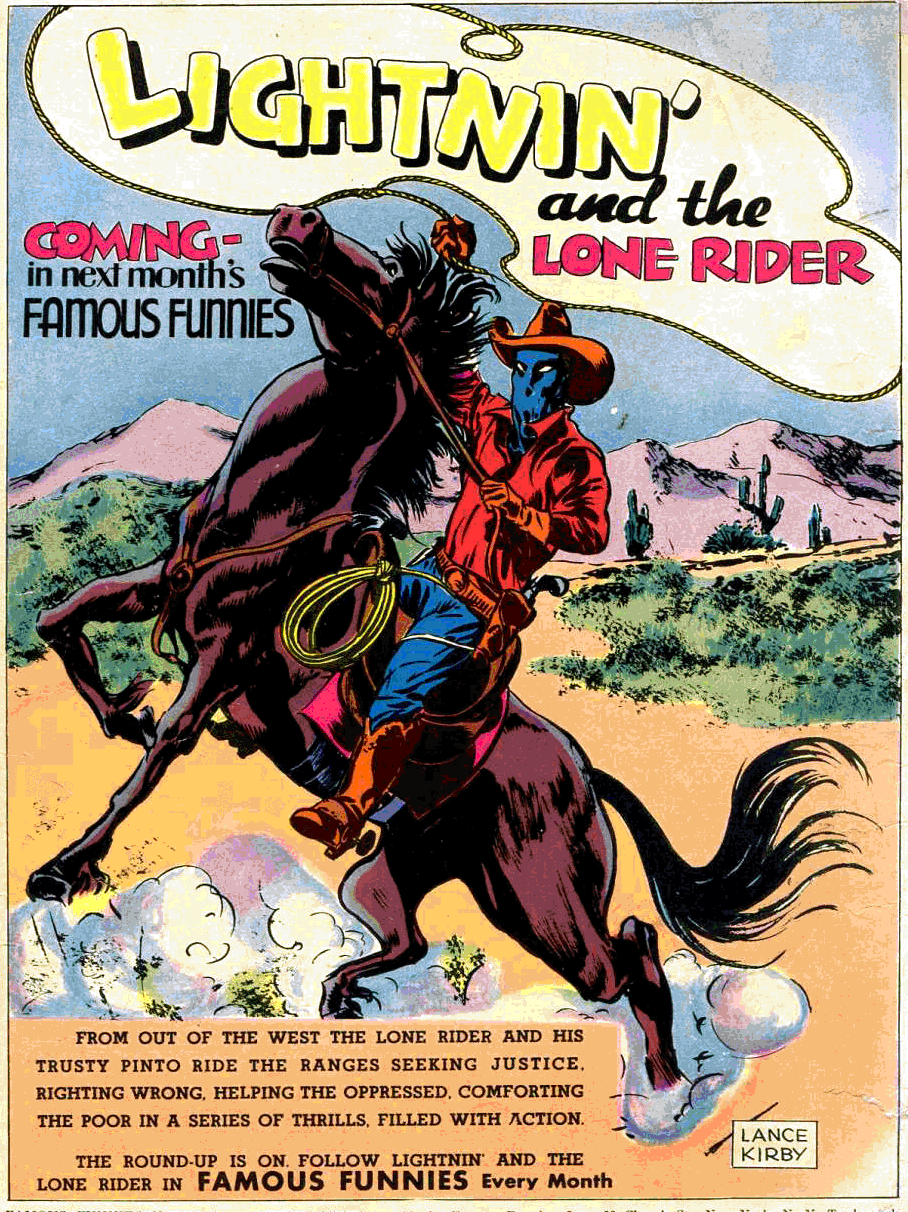
Lone Rider: 1938, Lightnin' and the Lone Rider strip by Jack Kirby, reprinted in Famous Funnies. Rancher Jim Larrimore put on a black mask and costume and rode his horse Lightning to fight injustice in the American West. While his adventures at first seemed to be the Old West, in an adventure starting in issue 66, elements of the modern day started showing up such as television screen and motor boats. The Lone Rider was also a character that had his own book put out by Ajax-Farrell, although whether it was the same character or not... the basic look was at least the same. Here he also had an Indian lad as a sidekick named Bright Leaf.
|
|
Lone Warrior: 1941, Banner #3 (Ace). Before he died Dr. Carter innoculated his two
sons, Stan and Dicky, with the "Power Elixir." This gave them a W-shaped
scar on their chest and above human speed, strength and endurance.
Even though Stan is enlisted in the army, he still has time to put on a costume and team up with his brother as the Lone Warrior and Dicky. Considering that makes him hardly the "Lone" Warrior, and Dicky didn't bother to come up with a code-name, guess we can assume above average intelligence wasn't one of the benefits of the inoculation.
Their father also invented the all-purpose "Wonder Ship", an airplane with the propellor and main wings retractable. On the roads it looks like the wingless airplane that it is. |
| |
Long Bow: 1950, Jumbo Comics #141 (Fiction). Long Bow is a lad from the Blackfoot indian tribe during colonial American days. His father Great Bow and mother Looking Glass are killed by members of the Crow tribe. He takes up with the kind Trapper Jim and has adventures. His stories also took place in Fiction's Indians title starting the same year. |
| |
Lucifer, the White Devil: 1940, Super Spy #1 (Centaur). Lucifer is actually a good guy. He's basically a clone of Congo Bill, an adventurer hanging out in the jungles of Africa. Because of his skills in tracking and such, he gets called in by the local constabulary to find some explorers that had gone missing looking for a lost city. He finds them captive by a blood-thirsty tribe, rescues them and helps them find the city and its treasure. He's helped by Lahu, a native lad. He lightly chastises him when he risks his life for the gold, saying Lahu's more valuable than treasure. |
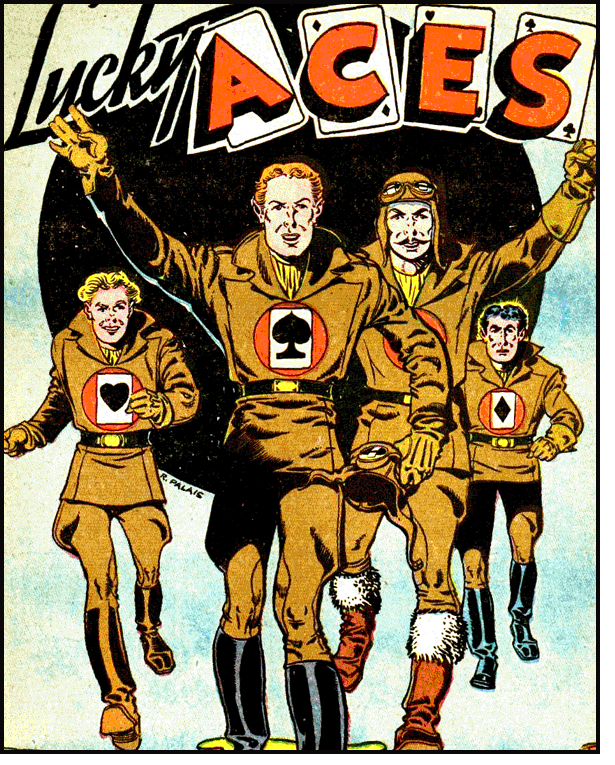 |
Lucky Aces: 1945, Eagle Comics #2 (Rural). 1918, France, four pilots of the Dawn Patrol are known as the Lucky Aces. Ace of Diamonds is Roger Mac Donald, scion of a wealthy Baltimore family. Ace of Clubs is Lt. Larry Harkness, former race car driver. Ace of Spades is Jerry Frisco, ex-boxer, bodyguard and football pro, but now the lucky “Ace”. Ace of Hearts is Gregory Abbott, ex-artist and actor. After the War, they reunite first every ten years. Larry becomes president of the Central Airlines. Then, during another reunion, one fateful December day in 1941, War breaks out anew. They re-enlist, retaining their ranks as lieutenants. Stationed on an island known as “X” their job is to train new recruits, and to once more fly dawn patrol. Their planes have their aces painted on them. While no longer the young bucks they once were, they have experience on their side. |
| |
Lucky Lee: 1941, Liberty Scouts #2 Centaur). Lee Gates is a superstitious man and he feels that he has a good luck gold coin. Through a series of lucky incidents, he makes a fortune, stops thieves, finds an island of beautiful Amazons and escapes certain death several times. |
| |
Lucky Wings: 1937, Funny Picture Stories #6? (Centaur). The Lucky Wings are Bill and Tom (the one with the mustache), two adventurous newsreel men who travel the world and face villains of all stripes in pursuit of their stories. Note: Look under "W" for another Lucky Wings. |
| |
Lucky Lucifer: 1940, Colossus Comics #1 (Sun). Pilot Lucky Lucifer doesn't wait for America to enter the War as he goes to England and joins them to fight the Axis. His plane is marked by a horseshoe and a devil's head. He's helped by his American buddy Slipstream Barry. |
|
|
Luckyman:
1945, Star Studded Comics #1 (Cambridge House). Able seaman Danny
Barr is incredibly lucky which he uses to be bad luck against crooks.
Wonder how long his luck will keep him safe from apparently being
a chain smoker though. |
|
Lu-nar: 1941, Wonderworld Comics 28-33 (Fox). Lu-nar or Lunar is an
alien with some super-strength who seems to be a bit of the Johnny Weissmuller Tarzan type in his outlook
on Earth civilization. But, to his cab driver buddy Beanie's dismay, he goes
about doing the superhero stuff. Basically a good-natured humerous super-hero
strip along the nature of Johnny Thunder as opposed to Super-Snipe. |
|
Lynx: 1940, Mystery Men #14 (Fox Features). "Endowed by a famous biologist with tremendous energy to overcome all obstacles", Jim goes after racketeers as the Lynx with the help of Blackie the Mystery Boy. The story goes, he was originally the Moth but due
to possibilities of a lawsuit from National (Batman), the name was changed on
the already finished boards, thus he had the superpower of flight and a much
different costume than later. In issue #27, he gets a girlfriend, Anna Ryan who is an ex-gun moll with a pretty good left hook though not a good shot. She is unaware that her boyfriend is the costumed hero, even though the kid sidekick has the same name. |